AI estimate as of August 1, 2025 · verify with a professional before acting
AI-Generated · Verify before acting
Everything on this page is generated by AI for informational purposes only. AI can make mistakes — the AI may misidentify items or misattribute them (artist, maker, brand, designer, origin, era). This is not an official valuation and should not be used for insurance, sale, tax, estate, legal, or lending purposes — or any decision requiring a certified appraisal. It is not an authoritative claim about any person, brand, or rights holder — do not share or rely on it as a factual statement about a third party. Always consult qualified professionals before making financial decisions.
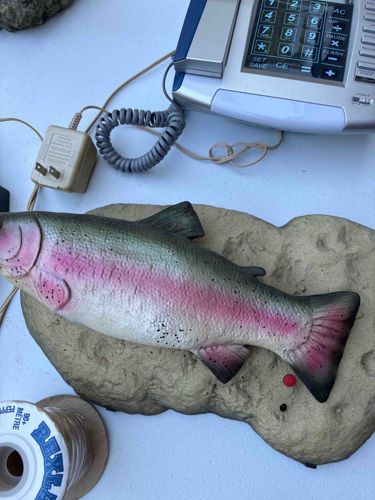
This item is a wall-mounted taxidermy or replica of a Rainbow Trout, designed to mimic a fish mounted on a plaque after being caught. The fish itself appears to be a replica, likely made from plaster, resin, or a similar composite material, and then painted to realistically represent a Rainbow Trout. Key physical characteristics include its elongated body, well-defined fins (dorsal, pectoral, pelvic, anal, and caudal), and gills evident near the head. The coloring is vibrant and mimics natural trout patterns, featuring a dark olive-green to bluish-green upper body transitioning to lighter sides with a prominent, irridescent pinkish-red stripe running horizontally along the lateral line. The belly is a lighter, creamy white. Black spots are scattered across its back and sides, particularly visible on the upper part of the body and fins. The eyes appear to be artificial, likely glass or plastic, adding to the lifelike quality. The fish is mounted on a roughly shaped, textured base designed to resemble natural rock or riverbed material, colored in shades of light brown or beige, suggesting an outdoor, natural habitat. The overall craftsmanship suggests it's a decorative piece rather than a scientific specimen. There are visible condition issues, particularly areas where the paint appears to be chipped or worn, revealing lighter material underneath, especially on the body of the fish and the edges of the base. The base has two small, dark circular indentations, and one small red circular marking near the tail end of the fish, which may be part of the design or possibly small pieces of embedded material. There are no obvious maker's marks or signatures visible in the provided image. Based on the material appearance and style, it likely dates from the mid-to-late 20th century to early 21st century, falling into a contemporary decorative or "man cave" aesthetic. The quality is typical of mass-produced decorative items, aiming for realism without the precision of high-end artisanal taxidermy.
AI Appraisal Report
Upon visual examination of this wall-mounted Rainbow Trout replica, I observe a decorative piece, likely cast from resin or a similar composite, and hand-painted. The paint scheme effectively mimics a natural Rainbow Trout, featuring the characteristic pinkish-red lateral stripe and black spots. The form is well-executed for a decorative item, with distinct fin structures and artificial eyes contributing to its lifelike appearance. The fish is mounted on a textured, rock-like base, suggesting an outdoor theme.
Regarding condition, there are visible chips and paint wear, especially on the fish's body and the base's edges, revealing lighter material beneath. These are consistent with typical handling and age for such an item. The two small dark indentations and a red marking on the base appear to be minor anomalies, possibly manufacturing flaws, or embedded material rather than significant damage. Authenticity as a replica is evident; it is not a preserved fish specimen. Given the visual cues, it aligns with mass-produced decorative items from the late 20th to early 21st century, often found in 'lodge' or 'man cave' themed decor.
Market conditions for such pieces are generally stable but with limited high-end demand. Comparables include similar resin or plaster fish replicas sold through online marketplaces, sporting goods stores, or antique/flea markets. Demand is sporadic, typically from individuals seeking specific decorative elements rather than collectors of rare or artisanal taxidermy. Rarity is low; these were mass-produced. Factors significantly impacting value include its decorative appeal, condition, and the lack of specific maker's marks or provenance. The current condition issues, while superficial, do slightly diminish its aesthetic appeal and, consequently, its market value.
Limitations in authenticity verification from images alone include precise material identification and confirming the exact manufacturing process. An in-person examination would allow for tactile assessment of material, closer inspection of paint consistency, determination of weight, and the presence of any subtle maker's marks or labels not visible in photography. Provenance documentation, if available, could offer insights into its specific origin or if it was part of a larger collection. Without these, it's assessed primarily on its aesthetic and decorative merits as a common vintage-style accent piece.