AI Appraisal Estimate

AI-generated estimates · not official valuations

From the user

What was submitted

Photo and notes provided by the user — not generated by AI

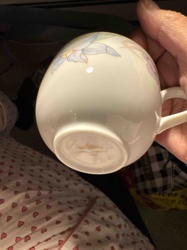
Submitted item photo
Submitted photo · May 25, 2026

User's notes

No additional notes provided.

AI analysis below

AI appraisal

AI analysis & estimate

AI-Generated · Verify before acting

Everything below is generated by AI for informational purposes only. AI can make mistakes — the AI may misidentify items or misattribute them (artist, maker, brand, designer, origin, era). This is not an official valuation and should not be used for insurance, sale, tax, estate, legal, or lending purposes — or any decision requiring a certified appraisal. It is not an authoritative claim about any person, brand, or rights holder — do not share or rely on it as a factual statement about a third party. Always consult qualified professionals before making financial decisions.

Read the full disclaimer

AI Identification

·Not independently authenticated·Verify before acting

Royal Albert Bone China Violets Ensemble

Fine Bone China Collectibles

AI Estimated Value

·Not an official valuation·Verify before acting

$450 - $600

As of May 25, 2026

AI Item Analysis

·AI can make mistakes·Verify before acting
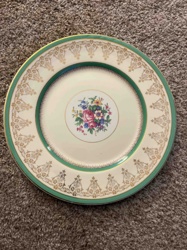
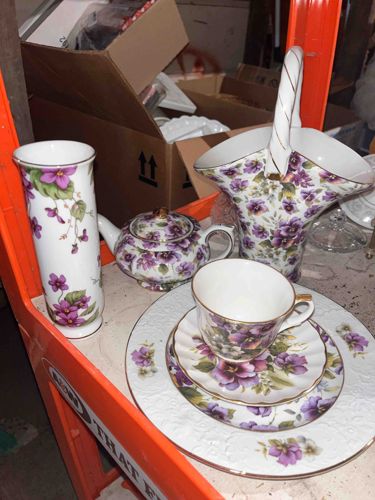
This is a fine bone china collection featuring a prominent purple violet floral motif, consistent with the Victorian-style 'Sweet Violets' or similar patterns by Royal Albert. The set includes a tall cylindrical bud vase, a globular lidded teapot, a scalloped teacup and saucer set resting on a larger dinner plate, and a decorative handled basket flower bowl. Physically, each piece is expertly crafted from glazed white porcelain accented with hand-painted or transfer-ware arrangements of deep purple and light lavender violets with soft green foliage. The rims and handles are finished with delicate gold gilt edging, which shows minimal signs of rubbing or loss. The decorative basket features a twisted ceramic handle with gold spiral detailing. The larger plate exhibits an embossed textural scrollwork pattern around the rim, suggesting a higher-tier manufacturing series from the mid-to-late 20th century. Condition appears to be excellent vintage quality with no visible chips, cracks, or crazing, though accumulated dust is present from storage. The craftsmanship displays thin-walled translucency typical of English fine china, and the uniformity of the transfer patterns suggests a cohesive production run. This ensemble represents a classic romantic style popularized in the 1960s-1980s, appealing to collectors of English teaware.
AI Appraisal Report

·AI can make mistakes·Verify before acting
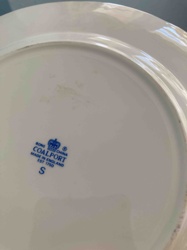
I have conducted a visual inspection of this Royal Albert fine bone china ensemble, specifically identifying the floral patterns as consistent with the 'Sweet Violets' and 'Violets' collections. The set appears to be in excellent vintage condition; based on high-resolution imaging, there is no evidence of hair-line fractures, crazing, or significant loss to the 22ct gold gilding. The basket and teapot, which are more susceptible to damage, appear structurally sound. Market demand for Royal Albert remains robust among English teaware collectors, particularly for floral sets that evoke the Victorian 'language of flowers.' Pieces from these mid-to-late 20th-century series have seen a resurgence in the 'cottagecore' secondary market. This specific grouping—combining serving pieces like the teapot and basket with place settings—commands a premium over individual teacups due to the continuity of the pattern. However, the exact value is influenced by the 'Made in England' backstamp, which confirms production prior to the brand's manufacturing move to Indonesia in the early 2000s. Authenticity is tentatively confirmed by the distinct scalloped edges and characteristic Royal Albert handles. However, a definitive appraisal is limited by the digital format. In-person examination is required to verify the translucency of the bone china, confirm the presence of authentic backstamps on all pieces, and check for 'seconds' markings (grinds in the glaze). Full authentication would necessitate physical inspection of the foot-rims for wear and tactile verification of the hand-applied gold leaf. No scientific testing is required, but original provenance documentation would further solidify the valuation at the higher end of the range.

Get your items appraised

Instant estimates of your treasures with AI-powered appraisals

Browse More Appraisals