AI estimate as of July 25, 2025 · verify with a professional before acting
AI-Generated · Verify before acting
Everything on this page is generated by AI for informational purposes only. AI can make mistakes — the AI may misidentify items or misattribute them (artist, maker, brand, designer, origin, era). This is not an official valuation and should not be used for insurance, sale, tax, estate, legal, or lending purposes — or any decision requiring a certified appraisal. It is not an authoritative claim about any person, brand, or rights holder — do not share or rely on it as a factual statement about a third party. Always consult qualified professionals before making financial decisions.
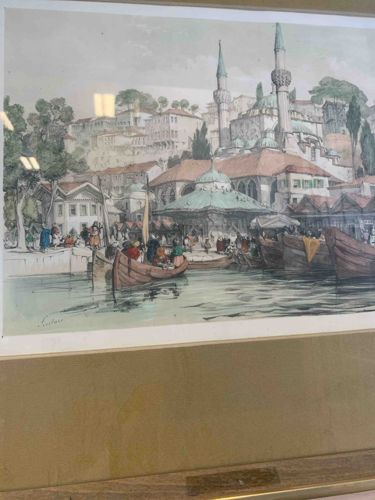
The item is a framed print, likely a hand-colored engraving or lithograph, depicting a vibrant urban scene that appears to be set in an Ottoman-era city, most probably Istanbul due to the architectural styles, particularly the mosques with multiple minarets. The artwork is presented within a simple, matted frame, which appears to be made of wood with a metallic or gold-toned finish. The overall dimensions are not provided, but it appears to be a medium-sized print suitable for wall display. The scene is bustling with activity, featuring numerous figures in traditional garb, boats on a body of water (likely the Bosphorus or Golden Horn), and a prominent fountain building in the foreground with a distinct green-domed roof. Behind this, a hillside is covered with traditional Ottoman houses and larger structures, including at least two mosques with multiple minarets, indicative of significant religious complexes. The color palette includes various shades of green for foliage and water, muted reds and browns for roofs and figures, and lighter tones for buildings and the sky. There is a visible signature in the lower left quadrant of the print, which appears to read 'Gutfred' or a similar name, though clearer resolution would be needed for definitive identification. The print exhibits some visible reflections on its surface from the protective glazing, suggesting it is under glass. The paper upon which the print is rendered shows some signs of age-toning, but no significant damage such as tears, rips, or prominent foxing is immediately apparent from the provided images. The matting appears clean and free of major blemishes. The frame itself shows some minor surface wear consistent with age and handling, but no significant structural damage. This type of artwork, depicting historical or exotic cityscapes, was popular in the 19th and early 20th centuries, suggesting an estimated age from that period. The quality of line work and coloring indicates a professional production.
AI Appraisal Report
Upon examination of the provided images, this item appears to be a 19th-century hand-colored print, likely a lithograph or engraving, depicting a cityscape consistent with Ottoman-era Istanbul. The subject matter, featuring daily life along the Bosphorus or Golden Horn with prominent mosques, was a popular theme for European artists and travelers during this period. The print appears to be in good condition for its age, with some visible age-toning to the paper but no major rips, tears, or staining. The matting is clean, and the frame shows only minor wear. The value is significantly influenced by the artist, the quality of the engraving, and the hand-coloring. The signature, possibly 'Gutfred,' is not immediately identifiable as a major artist from this period, which places the item in a more decorative category. Market comparables for similar anonymous or lesser-known 19th-century Orientalist prints typically range from the low to mid hundreds. Collectors and decorators actively seek these historical cityscapes, ensuring steady demand. However, a significant valuation increase would depend on identifying the artist as a notable figure. Limitations of this appraisal are substantial; without physical examination, I cannot confirm the printing method (engraving vs. lithograph), verify the age of the paper, or determine if the coloring is period-original. Full authentication would require de-framing the piece to inspect the paper, watermark, and plate marks, as well as typographic research to definitively identify the artist signature.