AI estimate as of July 26, 2025 · verify with a professional before acting
AI-Generated · Verify before acting
Everything on this page is generated by AI for informational purposes only. AI can make mistakes — the AI may misidentify items or misattribute them (artist, maker, brand, designer, origin, era). This is not an official valuation and should not be used for insurance, sale, tax, estate, legal, or lending purposes — or any decision requiring a certified appraisal. It is not an authoritative claim about any person, brand, or rights holder — do not share or rely on it as a factual statement about a third party. Always consult qualified professionals before making financial decisions.
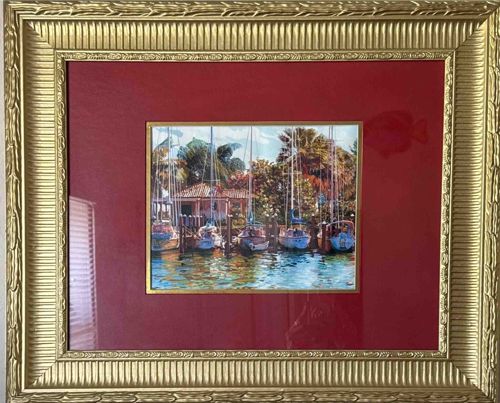
The item is a framed artwork featuring a vibrant watercolor or print depicting a marina scene. The central image, which appears to be a landscape painting, showcases a collection of sailboats docked in a body of water, likely a harbor or canal. In the background, there is a small building with a red-tiled roof, possibly a boathouse or part of a marina complex, nestled among lush tropical foliage, including prominent palm trees. The water is rendered in shades of blue and turquoise, with visible reflections of the boats and surrounding environment. The technique or medium appears to capture the essence of a bright, sunny day, with clear skies suggested by the light. The artwork itself is set within a wide, deep red mat board, which provides a striking contrast and draws attention to the central image. The mat board is free of visible tears or major blemishes. The entire piece is enclosed within a substantial, ornate gilded frame. The frame features a rich gold finish with intricate relief carvings on its inner and outer edges, suggesting either a classical or rococo influence. These decorative elements include fluting or reeding patterns, as well as vine-like or floral motifs. The gilding shows some minor signs of wear consistent with age, such as slight tarnishing or minor abrasions on raised areas, contributing to a desirable patina. There are no obvious signs of significant damage to the frame, such as large chips or cracks. The artwork is protected by a clear pane, likely glass or acrylic, which exhibits some reflections in the photographic image, but no apparent scratches or haziness. No artist's signature, title, or edition number is immediately visible in the provided image; such details would typically be located in the lower corners of the artwork or on the reverse side of the frame. The overall presentation suggests a well-cared-for piece, likely from the mid to late 20th century, given the style of the frame and potential subject matter common in that period.
AI Appraisal Report
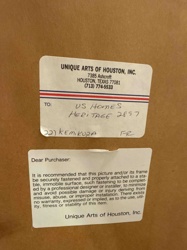
Upon visual examination of this framed marina scene, I find a decorative piece in very good overall condition. The artwork, appearing to be a print or watercolor, depicts a vibrant harbor scene and is well-preserved. The wide, red mat board is clean and provides a dramatic contrast. The ornate, gilded frame is a significant feature, exhibiting intricate classical or rococo-style relief carvings. While there are minor signs of age-appropriate wear, such as slight abrasions on the gilding, these contribute to a pleasing patina and do not detract from its aesthetic appeal. There is no visible artist signature, which is the most significant factor limiting its value. Without attribution to a known artist, the piece is valued as decorative art. The market for unsigned, decorative landscapes of this nature is broad but typically commands more modest prices. Comparable sales for well-framed, unsigned 20th-century decorative paintings or prints of similar size and quality typically fall within the $100 to $300 range. Its primary value lies in its strong decorative quality, driven by the attractive imagery and the high-quality, ornate frame. A definitive appraisal would require further investigation. My valuation is limited by the inability to inspect the artwork out of its frame, search for a hidden signature, or examine the reverse for any labels or inscriptions. Verifying whether the piece is an original watercolor versus a print would require microscopic examination. Full authentication would necessitate identifying an artist and establishing provenance through documentation.