AI estimate as of September 25, 2025 · verify with a professional before acting
AI-Generated · Verify before acting
Everything on this page is generated by AI for informational purposes only. AI can make mistakes — the AI may misidentify items or misattribute them (artist, maker, brand, designer, origin, era). This is not an official valuation and should not be used for insurance, sale, tax, estate, legal, or lending purposes — or any decision requiring a certified appraisal. It is not an authoritative claim about any person, brand, or rights holder — do not share or rely on it as a factual statement about a third party. Always consult qualified professionals before making financial decisions.
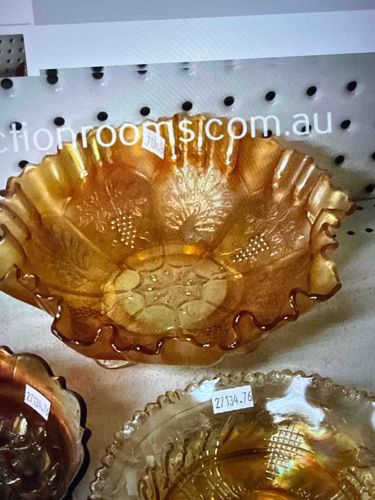
This item is a beautiful example of a ruffled berry bowl made from iridescent carnival glass, specifically in the 'Marigold' colorway, which presents with vibrant amber, orange, and slight reddish-gold hues. The bowl features a distinct ruffled or crimped edge, giving it an ornate and somewhat playful appearance. The primary decorative motif is an interior pressed pattern, commonly referred to as a 'grape and cable' or similar fruit-and-vine design, visible throughout the bowl's surface. Within the center of the bowl, a more intricate, medallion-like feature is present, possibly depicting a specific floral burst or geometric star pattern. The relief of these patterns is quite pronounced, catching and refracting light in varied ways due to the iridescent finish. There are no immediately visible cracks, chips, or significant damage, suggesting it is in at least good condition. The iridescence appears well-preserved, showing the characteristic shimmering effects that give carnival glass its name. The bowl's construction is typical of pressed glass from the early 20th century, likely dating from the 1900s to the 1930s, the peak period for carnival glass production. There are no discernible maker's marks from the image, which is common for many pieces of carnival glass. The craftsmanship is evident in the detailed pressing and the consistent application of the lustrous finish, indicative of a quality piece from its era. The visible price sticker hints at a retail or auction environment.
AI Appraisal Report
Based on my visual examination of the provided image, this Carnival Glass Ruffled Berry Bowl in Marigold appears to be a genuine example of early 20th-century pressed iridescent glass. The vibrant 'Marigold' colorway, characterized by its amber, orange, and reddish-gold hues, is consistent with known examples. The 'grape and cable' or similar fruit-and-vine internal pattern and the central medallion design are common and well-regarded motifs in carnival glass. The ruffled or crimped edge further adds to its classic appeal.
From the image, the condition appears to be very good; I observe no visible chips, cracks, or significant damage. The iridescence seems well-preserved, which is crucial for the aesthetic and value of carnival glass. The distinct light refraction suggests a quality piece. Authenticity, based solely on the visual cues in the image, seems high for an authentic carnival glass piece, likely produced between 1900-1930. The lack of a visible maker's mark is typical.
Regarding market conditions, carnival glass, while popular, has seen some fluctuation in demand. Common patterns like 'grape and cable' are widely available. Marigold is a prevalent color, generally commanding mid-range prices compared to rarer colors. This bowl is a standard berry bowl size, which is not particularly rare. Factors impacting value positively are its seemingly excellent condition and strong iridescence. The retail sticker in the image indicates a secondary market presence.
For full authentication and a more precise valuation, an in-person examination would be necessary to detect any subtle surface scratches, minor manufacturing flaws, or repairs not visible in the photo. Physical inspection also allows for a definitive assessment of the iridescence's quality and any wear. Documentation of provenance, if available, could also enhance its value. Without these, my appraisal is based purely on the visual data presented.