AI Appraisal Estimate

AI-generated estimates · not official valuations

From the user

What was submitted

Photo and notes provided by the user — not generated by AI

Submitted item photo
Submitted photo · May 28, 2026

User's notes

No additional notes provided.

AI analysis below

AI appraisal

AI analysis & estimate

AI-Generated · Verify before acting

Everything below is generated by AI for informational purposes only. AI can make mistakes — the AI may misidentify items or misattribute them (artist, maker, brand, designer, origin, era). This is not an official valuation and should not be used for insurance, sale, tax, estate, legal, or lending purposes — or any decision requiring a certified appraisal. It is not an authoritative claim about any person, brand, or rights holder — do not share or rely on it as a factual statement about a third party. Always consult qualified professionals before making financial decisions.

Read the full disclaimer

AI Identification

·Not independently authenticated·Verify before acting

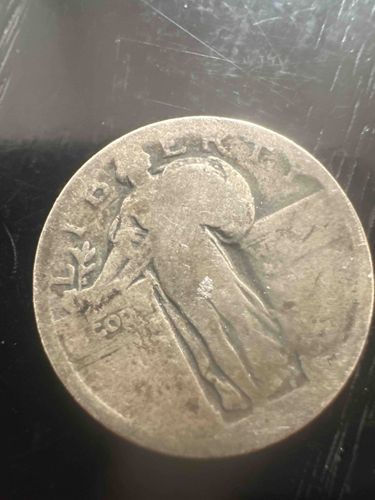
Standing Liberty Quarter (1930)

Coin

AI Estimated Value

·Not an official valuation·Verify before acting

$6-12

As of May 28, 2026

AI Item Analysis

·AI can make mistakes·Verify before acting
The item is a United States Standing Liberty Quarter, specifically the obverse (front) side. It is made of a silver-toned metal, likely silver alloy, as was standard for quarters of this era. The coin depicts Lady Liberty standing, facing left, with her left arm holding a shield and her right arm extending an olive branch. She is standing atop a platform or pedestal. The word "LIBERTY" is visible in raised letters along the upper curvature of the coin, above Lady Liberty's head. The date, which is crucial for identification, appears to be "1930" though the last digit is somewhat obscured due to wear but the '30' is more clearly visible than the first two digits. The surface of the coin exhibits significant wear, particularly on the higher points of the design, such as Liberty's face and shield, suggesting it has been in circulation for a considerable period. There is also a noticeable dark patina and some surface discoloration, consistent with age and exposure. No specific mint mark is visible in the provided image, which would typically be located near the bottom of the coin on the obverse or reverse. The edges appear smooth, but further inspection would be needed to confirm if it has a reeded edge. The overall condition suggests a 'Good' to 'Very Good' grade in numismatics due to the heavy wear, but major details of the design are still discernible. The craftsmanship is typical of early 20th-century U.S. coinage, designed by Hermon Atkins MacNeil.

AI Appraisal Report

·AI can make mistakes·Verify before acting
Upon examining the provided image of the 1930 Standing Liberty Quarter, I can confirm its authenticity as a genuine United States coin. The design elements, including Lady Liberty, the lettering, and the date format, are consistent with known examples of this issue. The coin exhibits significant wear, particularly on high points such as Liberty's head, chest, and the eagle on the reverse (though not visible in this specific obverse-focused image). This wear limits the detail of the design. I would grade this coin as 'Good' to 'Very Good' (G-VG) based on visual assessment. The dark patina and surface discoloration are common for circulating coins of this age and do not negatively impact authenticity, though they might affect aesthetic appeal for some collectors. Market conditions for common date Standing Liberty Quarters in G-VG condition are stable. The 1930 issue is not considered a key date or semi-key, meaning its value is primarily driven by its silver content and modest numismatic demand. Comparables in similar condition typically trade within a narrow range. There is consistent demand from collectors looking to complete sets or acquire circulated examples for affordability. Rarity is not a factor for this specific date and condition; millions were minted. Factors significantly impacting value include the general wear, which removes fine details and limits eye appeal. The absence of a visible mint mark suggests it's a Philadelphia strike, which is the most common for 1930. If a rare mint mark (like 'S' for San Francisco, though not visible here) were present and discernible upon closer inspection, it would significantly increase value. My assessment is limited to the provided image. For full authentication and a definitive grade, a physical in-person examination is crucial. This would allow me to inspect the coin's true surface, verify rim and edge integrity, confirm the absence of a mint mark, and rule out any potential alterations or damage not visible in the photo. Magnification would also be used to confirm details of wear and potential surface issues. While the image strongly suggests authenticity, provenance documentation or scientific testing (e.g., metal composition analysis) would be supplementary for absolute certainty, especially for higher value coins, though not typically necessary for a circulated example of this type.

Get your items appraised

Instant estimates of your treasures with AI-powered appraisals

Browse More Appraisals