AI estimate as of June 29, 2025 · verify with a professional before acting
AI-Generated · Verify before acting
Everything on this page is generated by AI for informational purposes only. AI can make mistakes — the AI may misidentify items or misattribute them (artist, maker, brand, designer, origin, era). This is not an official valuation and should not be used for insurance, sale, tax, estate, legal, or lending purposes — or any decision requiring a certified appraisal. It is not an authoritative claim about any person, brand, or rights holder — do not share or rely on it as a factual statement about a third party. Always consult qualified professionals before making financial decisions.
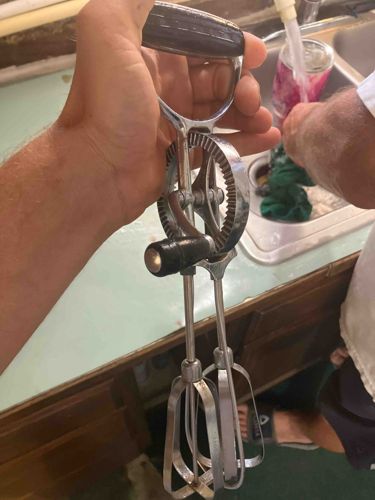
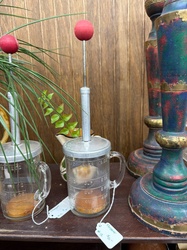
The item is a vintage hand-cranked egg beater, a classic culinary tool designed for manual whipping and aerating of ingredients. It primarily consists of a sturdy metal frame, likely chrome-plated steel or aluminum, presenting a bright silver appearance with some typical signs of age and use. The main handle, intended for gripping, is dark-colored, possibly made of bakelite, hard plastic, or dark wood, exhibiting a slight sheen and some minor surface wear. Across from the grip handle, a rotating crank arm extends, terminating in a smaller, similarly dark-colored handle for turning the mechanism.
The core of the beater's functionality is its exposed gear system. A large, prominent gear wheel is centrally mounted within the frame, driven by a smaller gear attached to the crank arm. This large gear, in turn, meshes with two smaller gears positioned at the top of the beater shafts. These shafts extend downwards, each terminating in multi-bladed wire whip assemblies, constructed from what appears to be lightweight metal strips formed into loops. The rotation of the crank causes the beaters to spin rapidly in opposing directions, ensuring efficient mixing.
Visually, the beater displays a utilitarian aesthetic characteristic of kitchen tools from the mid-20th century, likely dating from the 1940s to the 1960s. There are no overt signs of damage or repairs, although the item shows a pleasing patina consistent with regular use over many years. Minor scratches and dulling of the metallic finish are present, particularly on the beaters themselves, suggesting their practical application in food preparation. The overall construction appears robust and functional, indicative of durable craftsmanship common in household appliances of that period. No specific manufacturer's marks are discernible from the available image.
AI Appraisal Report
Upon my examination of the provided images, this vintage hand-cranked egg beater appears to be in good, used condition, consistent with its likely age from the mid-20th century (1940s-1960s). The metal frame, described as chrome-plated steel or aluminum, displays a pleasing patina with minor scratches and dulling appropriate for regular use. The dark-colored handles, possibly bakelite or hard plastic, show slight surface wear but retain their sheen. The exposed gear system and wire whip assemblies appear robust and functional with no overt signs of damage or repairs. Its utilitarian aesthetic is typical for the period, lending authenticity as a genuine vintage item.
In terms of market conditions, vintage hand-crank egg beaters are relatively common on secondary markets such as online auction sites, antique stores, and flea markets. Demand is moderate, primarily from enthusiasts of vintage kitchenware or collectors seeking functional retro tools. The item itself is not particularly rare given the general ubiquity of such kitchen implements in the mid-20th century.
Several factors significantly impact the value of such an item. Crucially, the absence of discernible manufacturer's marks from the images limits its potential value, as brand-name examples (e.g., A&J, Dover) typically command higher prices. While its condition is good, a near-mint or unused example would also fetch more. As a common design, there are no unique features that would elevate its rarity or demand significantly.
It is important to note the inherent limitations of appraising from images alone. I cannot definitively verify the exact material composition of the handles (e.g., bakelite vs. plastic) without physical inspection. Moreover, without in-person examination, one cannot fully ascertain the internal integrity of the mechanism, nor confirm the originality of all components. Specific manufacturer marks or patent numbers, often crucial for precise dating and valuation, may be present but not visible in the provided imagery.