These notes were written by the person who submitted this item. Appraiser.AI has not verified them, and the AI's identification and estimate may rely on them.
AI Estimated Value
Not an official valuation
$600 - $1,100
AI estimate as of September 28, 2025 · verify with a professional before acting
AI-Generated · Verify before acting
Everything on this page is generated by AI for informational purposes only. AI can make mistakes — the AI may misidentify items or misattribute them (artist, maker, brand, designer, origin, era). This is not an official valuation and should not be used for insurance, sale, tax, estate, legal, or lending purposes — or any decision requiring a certified appraisal. It is not an authoritative claim about any person, brand, or rights holder — do not share or rely on it as a factual statement about a third party. Always consult qualified professionals before making financial decisions.
This analysis also relies on unverified notes provided by the user, which may be incomplete or inaccurate and could affect the result.
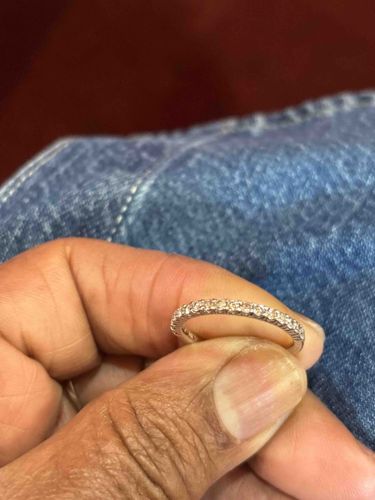
This item is a diamond eternity band, likely crafted from white gold or platinum, given its silvery-white metallic appearance. The band exhibits a continuous line of small, round brilliant-cut diamonds across its top surface, indicating it is a 'front-half' or 'top-half' eternity style, as the diamonds do not appear to wrap fully around the circumference. The diamonds are uniformly sized and closely set, suggesting a pavé or channel setting, though the resolution makes precise identification difficult. Each diamond, although small, appears to possess a noticeable sparkle, suggesting good cut quality. The craftsmanship seems fine, with a smooth, polished finish on the visible metalwork. There are no readily apparent manufacturing marks or signatures visible from this angle. The ring appears to be in good condition, with no obvious signs of significant wear, damage, or missing stones. The metal has a bright luster, indicating it has been well-maintained or recently polished. While the exact age is undeterminable without markings, the classic design suggests it could be contemporary or from a relatively modern style period (late 20th to early 21st century). The overall impression is one of elegance and understated luxury, commonly worn as a wedding band, anniversary ring, or stacking ring with other pieces of jewelry. The width of the band is relatively narrow, contributing to its delicate aesthetic.
AI Appraisal Report
Based on my visual examination of the provided image, I am assessing this diamond eternity band. The ring appears to be a 'front-half' or 'top-half' eternity style, featuring a continuous line of small, round brilliant-cut diamonds across the visible top surface. The silvery-white metallic appearance suggests it is likely crafted from white gold or platinum. The diamonds are uniformly sized and closely set, indicating a pavé or channel setting, though the precise setting style is difficult to ascertain from the image resolution. Each diamond, despite its small size, exhibits noticeable sparkle, pointing to good cut quality. The craftsmanship seems fine, with a smooth, polished finish on the metalwork. The item appears to be in good condition, with no visible signs of significant wear, damage, or missing stones. The bright luster suggests good maintenance or recent polishing.
In terms of market conditions, similar diamond eternity bands, especially those with smaller, numerous diamonds and 'front-half' settings, are consistently in demand for wedding bands, anniversary gifts, or stacking. While not rare, the combination of good condition and apparent quality ensures a steady market. Factors significantly impacting value include the total carat weight of the diamonds, the metal type (platinum being more valuable than 10k or 14k white gold), and the exact clarity and color grades of the stones. The narrow width contributes to its delicate aesthetic, which is popular.
It is crucial to note the limitations of this appraisal. Autonomy and exact specifications cannot be definitively determined from images alone. A full authentication would require an in-person examination to verify the metal's purity (e.g., 14k white gold vs. platinum), accurately assess the total carat weight, color, and clarity of the diamonds, and identify any hidden hallmarks or manufacturer's marks. Scientific testing, such as specific gravity tests or XRF analysis for metal composition, would confirm authenticity. Without physical inspection, precise diamond grading and metal identification are impossible, which could shift the final valuation.