AI estimate as of September 4, 2025 · verify with a professional before acting
AI-Generated · Verify before acting
Everything on this page is generated by AI for informational purposes only. AI can make mistakes — the AI may misidentify items or misattribute them (artist, maker, brand, designer, origin, era). This is not an official valuation and should not be used for insurance, sale, tax, estate, legal, or lending purposes — or any decision requiring a certified appraisal. It is not an authoritative claim about any person, brand, or rights holder — do not share or rely on it as a factual statement about a third party. Always consult qualified professionals before making financial decisions.
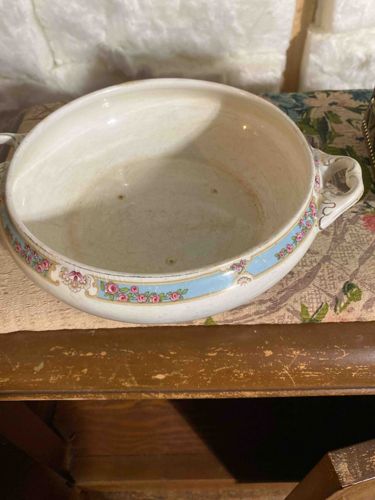
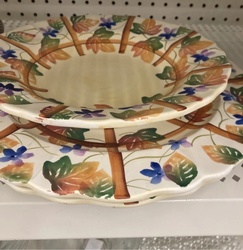
This is a vintage ceramic serving bowl, likely made of earthenware or porcelain, featuring a decorative floral band. The bowl is of a substantial size, indicating its use for serving larger portions. Its primary color is an off-white or cream, which has developed a subtle patina or discoloration with age, visible as brownish-orange tints on the interior surface, particularly towards the bottom. The interior also shows what appear to be three small, dark pinprick marks, possibly manufacturing flaws, residues, or small chips. The exterior is adorned with a prominent decorative band, approximately 1 to 1.5 inches wide, encircling the bowl. This band features a light blue ground, upon which are depicted clusters of small pink roses with green leaves. The ends of the blue band meet or are framed by more elaborate, scrolling floral or foliate motifs in darker shades, possibly incorporating burgundy or a similar deep color, along with hints of gold or yellow accents. The bowl has two distinct handles, one on each side, which are integrated into the design. These handles are C-shaped with a slight curl or scroll at the ends, echoing the more intricate decorative elements of the band, and are also in the same cream color as the main body. The craftsmanship appears to be good for a mass-produced item of its era, with a smooth, glazed finish suggesting practical use. There are no visible chips or cracks on the rim or the exterior, apart from the internal discoloration. The style of the floral decoration and the general form suggest a mid-20th century aesthetic, possibly late Art Deco or early Mid-Century Modern, though it could also be earlier, dating to the turn of the 20th century, given the slight Victorian or Edwardian influence in the handles and detailed band.
AI Appraisal Report
Upon visual examination of this vintage ceramic handled serving bowl, I assess its condition as good, consistent with its likely age. The primary off-white/cream body shows a subtle, age-appropriate patina and discoloration on the interior, a common occurrence in older ceramics from use and exposure. The three small dark marks inside appear to be minor manufacturing imperfections or residue, not significant damage. Crucially, there are no visible chips or cracks on the handles, rim, or exterior, which is positive for its value. The decorative floral band, with its pink roses on a light blue ground, remains vibrant, and the scrolling foliate motifs appear intact.
autenticity, based on design elements, this bowl strongly aligns with mid-20th century aesthetics, possibly late Art Deco or early Mid-Century Modern (1930s-1950s). The integrated C-shaped handles and floral decoration suggest it was a mass-produced item for everyday or semi-formal use. While charming, extensive demand for such pieces is generally moderate, as they are not exceedingly rare.
Market comparables for similar vintage ceramic serving bowls with comparable condition and decorative styles typically range within the $40-$70 bracket. Factors impacting value include the lack of any significant damage, the appealing floral design, and its functional size. However, it's not a rare designer piece or made by a renowned manufacturer, limiting its upper valuation. Slight staining on the interior also nudges it towards the lower end of its 'good' condition range.
Limitations: My assessment of condition and authenticity is based solely on the provided image. A full in-person examination would be necessary to confirm the absence of hairline cracks, chips, or repairs not visible in the photo, and to properly identify the ceramic body (e.g., earthenware, porcelain). Provenance documentation (e.g., original receipts, family history) or scientific testing would be needed for definitive authentication of its exact age or manufacturer, though the visual cues are strong enough for a general appraisal.