AI estimate as of July 7, 2025 · verify with a professional before acting
AI-Generated · Verify before acting
Everything on this page is generated by AI for informational purposes only. AI can make mistakes — the AI may misidentify items or misattribute them (artist, maker, brand, designer, origin, era). This is not an official valuation and should not be used for insurance, sale, tax, estate, legal, or lending purposes — or any decision requiring a certified appraisal. It is not an authoritative claim about any person, brand, or rights holder — do not share or rely on it as a factual statement about a third party. Always consult qualified professionals before making financial decisions.
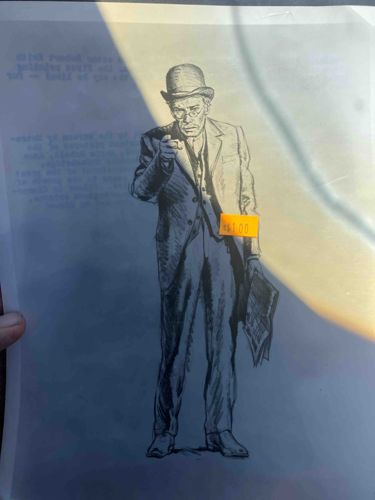
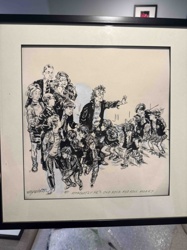
The item is a black and white print or illustration depicting a full-body male figure. The man appears to be middle-aged or older, with a somewhat stern expression. He is wearing a bowler hat, glasses, a suit jacket, a vest, and trousers, consistent with early 20th-century or mid-20th-century attire. His left hand is raised, pointing directly towards the viewer, reminiscent of the famous 'Uncle Sam Wants You' propaganda poster. His right hand is holding what appears to be a folded newspaper or document. The artwork is rendered with distinct pen-and-ink crosshatching and line work, giving it a somewhat gritty or traditional illustrative feel. The colors are limited to shades of black and white, suggesting a charcoal drawing, pen drawing, or a monochrome print of such. The paper appears to be standard white or off-white. There are visible creases or folds on the paper, indicating handling or storage issues. A bright orange sticker with '51.00' (likely a price tag for $1.00) is affixed to the right side of the figure's midsection, covering part of the illustration. A strong light source, possibly sunlight, is casting a bright, diagonal beam across the upper left and lower right portions of the image, obscuring some details and suggesting the item is not perfectly flat or is being photographed under specific lighting. The visible text on the left side of the paper, behind the figure, seems to be standard printed text, suggesting this might be an illustration from a book, magazine, or a standalone print on a piece of paper with other content. The quality of the drawing suggests professional illustration work, possibly from a published source.
AI Appraisal Report
Upon examining the provided image of the 'Pointing Man Illustration,' I assess its condition as fair to poor. The visible creases, folds, and the prominent affixed price sticker significantly detract from its aesthetic and collectible value. The strong diagonal light obscures details and suggests issues with the item's flatness or photographic conditions. Authenticity is challenging to determine solely from an image. While the illustration style, with its distinct pen-and-ink crosshatching, suggests professional work from the early to mid-20th century, consistent with a magazine, book, or propaganda piece, definitive authentication of the artist or specific publication would require in-person examination. Without a signature, publisher's mark, or other identifying features, its origin remains speculative. Market conditions for unsigned, unauthenticated, and damaged vintage illustrations are generally low. Comparables would typically be found in ephemera or low-value art prints rather than fine art. Demand for such items is niche, primarily among collectors of vintage illustrations or specific historical periods. Rarity is unlikely for a potentially mass-produced print, though an original drawing would be rare; this appears to be a print. Key factors severely impacting value are the poor condition and the lack of provenance or artist attribution. The price sticker further diminishes appeal. For full authentication and a more precise valuation, I would need a physical inspection to examine the paper, print quality, presence of watermarks or publisher's marks, and to determine if it is an original drawing versus a print. Scientific testing could reveal inks or paper dating. Provenance documentation, if available, would be crucial.