AI Appraisal Estimate

AI-generated estimates · not official valuations

From the user

What was submitted

Photo and notes provided by the user — not generated by AI

Submitted item photo
Submitted photo · July 18, 2026

User's notes

Picture

AI analysis below

AI appraisal

AI analysis & estimate

AI-Generated · Verify before acting

Everything below is generated by AI for informational purposes only. AI can make mistakes — the AI may misidentify items or misattribute them (artist, maker, brand, designer, origin, era). This is not an official valuation and should not be used for insurance, sale, tax, estate, legal, or lending purposes — or any decision requiring a certified appraisal. It is not an authoritative claim about any person, brand, or rights holder — do not share or rely on it as a factual statement about a third party. Always consult qualified professionals before making financial decisions.

Note

This analysis also relies on unverified notes provided by the user, which may be incomplete or inaccurate and could affect the result.

Read the full disclaimer

AI Identification

·Not independently authenticated·Verify before acting

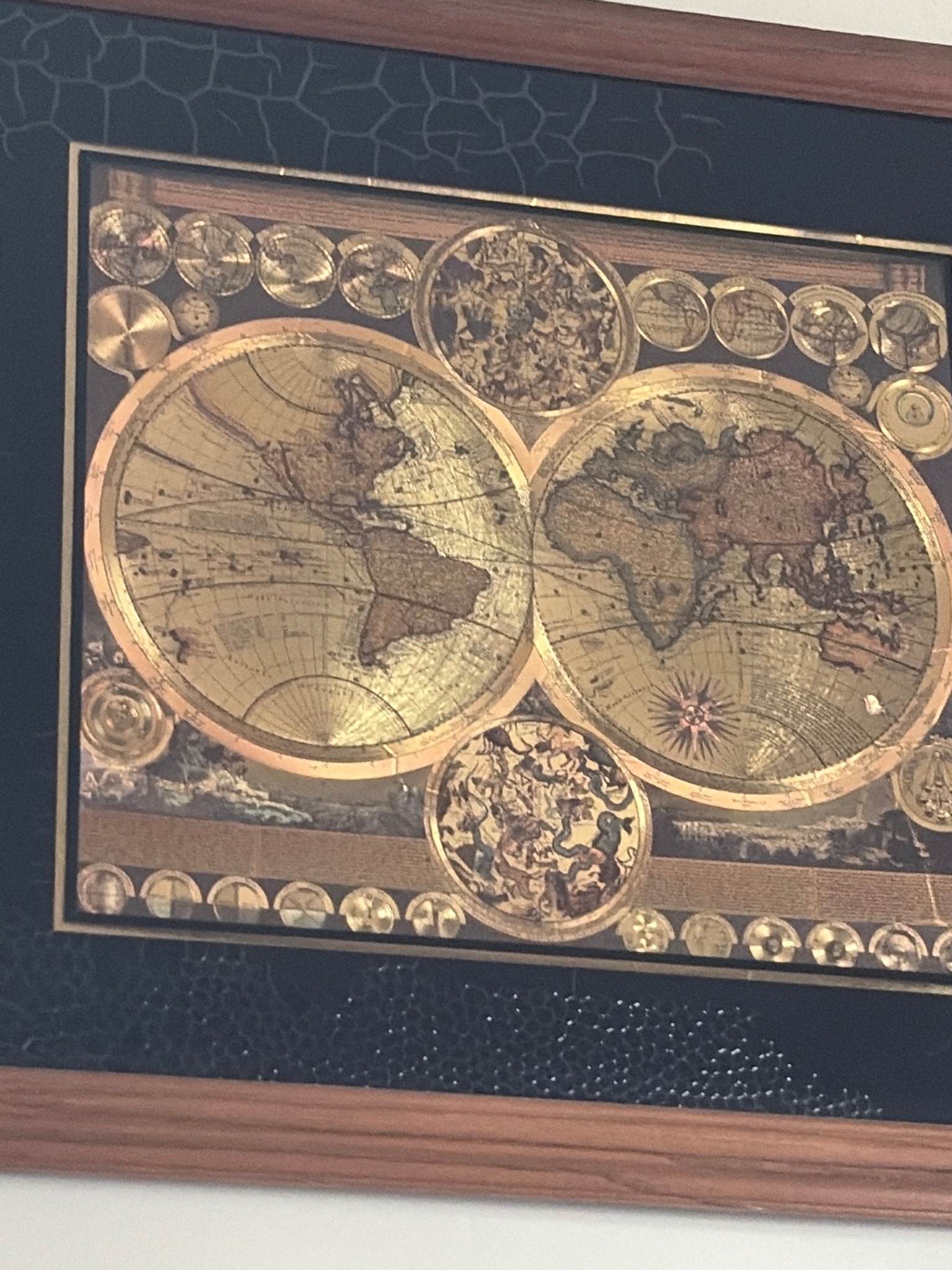
Foil-print world map in the style of 17th-century cartography

Wall Art

AI Estimated Value

·Not an official valuation·Verify before acting

$100 - $250

As of July 18, 2026

AI Item Analysis

·AI can make mistakes·Verify before acting
This item appears to be a decorative wall hanging featuring a double-hemisphere world map set against a series of smaller celestial or topical diagrams. The artwork is characterized by a reflective, metallic gold-tone surface, likely a foil-on-black-substrate print or engraving-style reproduction. The central composition depicts the Eastern and Western hemispheres in an antique style consistent with the Dutch Golden Age of cartography (roughly 17th century), though the material suggests it is a modern decorative reproduction. Notable visual elements include smaller circular insets illustrating constellations, zodiac signs, or regional views, and a compass rose. The piece is held within a wide black mat that features a distinct 'crackle' texture or faux-crocodile pattern, framed in a simple wood-toned moulding. No signature, publisher's mark, or date is legible in the image, so the identification remains a hypothesis based on stylistic elements. The condition shows some surface glare typical of metallic foil, and the framing appears intact. Such pieces were popular as home decor in the late 20th century. While the owner provides the context of a picture, no further specific provenance can be verified from this visual angle alone.

AI Appraisal Report

·AI can make mistakes·Verify before acting
Based on my visual analysis of the provided image, this item appears to possess the characteristics of a late 20th-century decorative foil-on-black-substrate reproduction. The composition reflects a hypothesis of 17th-century cartography, specifically mimicking the Dutch Golden Age style with double hemispheres and celestial diagrams. However, I cannot verify the physical age, the specific printing technique, or the material composition from a photograph alone. The metallic sheen suggests a common commercial production method rather than a period engraving or hand-applied gold leaf. Per the user's submission, this is identified as a picture of wall art, and my estimate assumes it is a well-preserved modern reproduction intended for interior design. The value of $100–250 covers the decorative appeal and the elaborate framing, which features a textured mat in a faux-crocodile or crackle pattern. I cannot confirm if the frame is solid wood or a composite material without closer inspection. In the general secondary market, furniture and decor stores often trade items of this style as 'statement pieces' where the value is driven by size and visual impact rather than historical rarity. If this were determined to be an exceptionally rare large-scale artist-signed print or part of a limited edition from a recognized design house, the value could increase slightly; conversely, if the foil surface shows scratches or the backing is compromised—details I cannot see clearly—the value would likely drop below $50. To confirm its origins, one would need to examine the piece out of the frame for publisher marks, verify the substrate type, and provide provenance documentation. Without a physical examination by a materials expert, this remains a decorative attribution.

Related Tags

Explore similar items and categories

Get your items appraised

Instant estimates of your treasures with AI-powered appraisals

Browse More Appraisals