AI estimate as of August 30, 2025 · verify with a professional before acting
AI-Generated · Verify before acting
Everything on this page is generated by AI for informational purposes only. AI can make mistakes — the AI may misidentify items or misattribute them (artist, maker, brand, designer, origin, era). This is not an official valuation and should not be used for insurance, sale, tax, estate, legal, or lending purposes — or any decision requiring a certified appraisal. It is not an authoritative claim about any person, brand, or rights holder — do not share or rely on it as a factual statement about a third party. Always consult qualified professionals before making financial decisions.
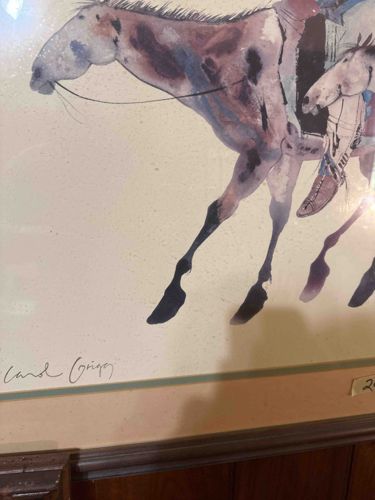
This item is a framed fine art print, appearing to be a reproduction of a watercolor painting. The central subject is a horse in motion, depicted in a distinct impressionistic or loose style characterized by broad washes of color rather than sharp, defined lines. The horse's coat shows a mottled pattern of browns, grays, and faint blues, possibly indicating an appaloosa or similar spotted breed. The horse wears a bridle, and a portion of what appears to be a rider's leg, clad in a boot with fringe, is visible on the right side, suggesting a Western riding theme or a rodeo scene. The background is a muted, light cream or beige color, providing a soft contrast to the horse. The signature 'Carol Grigg' is clearly visible in the lower left corner, indicating the artist. The print is housed within a matted frame; the matting is a neutral, light color that matches the background of the art, and the frame itself is a dark, possibly wooden, material with a traditional profile. The print appears to be in good condition, with no immediate signs of creasing, tears, or significant discoloration. The glass covering the print shows some glare, which is typical. The craftsmanship reflects a quality reproduction, likely from the late 20th or early 21st century, given the artistic style and apparent printing methods. The composition conveys dynamic movement and captures the essence of the subject rather than minute details, a hallmark of Grigg's style.
AI Appraisal Report
I have examined the provided image of what appears to be a framed Carol Grigg horse art print. The print shows a horse in an impressionistic style, with a visible 'Carol Grigg' signature in the lower left corner. The condition appears to be good; the print itself shows no obvious signs of damage such as tears, creases, or significant fading, and the matting and frame seem intact, though typical glare on the glass is observed.
Authenticity, based solely on this image, appears strong for a reproduction due to the clear signature aligning with known examples of Grigg's work. Carol Grigg is a recognized artist, particularly for her equestrian and animal-themed works, which are widely reproduced as prints. This is a common characteristic of her accessible market presence. The demand for her prints is generally consistent, but their widespread availability as reproductions means they are not rare. Market comparables for framed Carol Grigg prints of this size and type typically fall within the range of $75 to $150, depending on the specific image, framing quality, and sales venue.
Factors impacting value include the print's condition, the quality and style of the framing, and the artist's enduring popularity. While the visual evidence suggests good condition for a reproduction print, a critical limitation of this appraisal is the inability to definitively confirm authenticity as an authorized reproduction versus a counterfeit, or to distinguish it from an original watercolor, without physical inspection. An in-person examination would allow for inspection of print quality, paper type, and framing integrity. Furthermore, specific provenance documentation, such as a certificate of authenticity or purchase receipts, would be needed to verify its origins definitively. Scientific testing, like spectral analysis of inks, would be required to rule out later reproductions without authorization or to confirm if it were an original artwork, which is unlikely given the characteristics.