AI estimate as of September 3, 2025 · verify with a professional before acting
AI-Generated · Verify before acting
Everything on this page is generated by AI for informational purposes only. AI can make mistakes — the AI may misidentify items or misattribute them (artist, maker, brand, designer, origin, era). This is not an official valuation and should not be used for insurance, sale, tax, estate, legal, or lending purposes — or any decision requiring a certified appraisal. It is not an authoritative claim about any person, brand, or rights holder — do not share or rely on it as a factual statement about a third party. Always consult qualified professionals before making financial decisions.
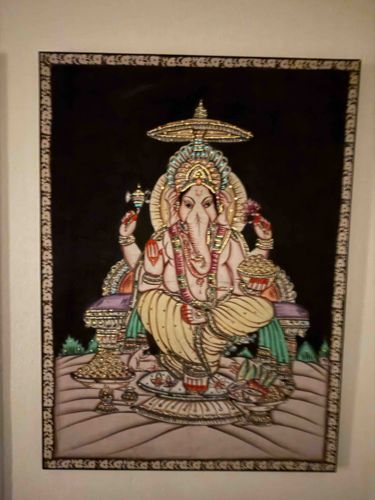
This is a framed painting depicting the Hindu deity Ganesha, rendered in a traditional style that appears to incorporate elements of Tanjore painting. The artwork features Ganesha seated prominently on a lavish throne, holding various implements in his four hands, characteristic of his iconography. His attire is a golden yellow dhoti, and he is adorned with numerous necklaces, armbands, and a prominent crown. The dominant color palette includes warm gold and yellow tones, pink for the skin, and accents of green, purple, and blue.
One of the most striking features is the extensive use of what appears to be embedded gilded elements, possibly embossed gold foil or raised gesso work, which gives the piece a three-dimensional, jewel-like quality. This technique is particularly visible on Ganesha's crown, jewelry, the throne, the stylized umbrella (chattra) above his head, and the borders of his attire. These raised sections show intricate patterns and contribute significantly to the visual richness. The background is a stark black, which makes the brightly colored and gilded figure stand out vividly. The painting is framed with a border that appears to have repeated patterns, possibly also incorporating gilded or textured elements, though the resolution limits a clear view.
While specific age is hard to determine from the image alone, the style suggests it is a modern rendition of traditional Hindu art, likely from the late 20th or early 21st century. The condition appears good, with no obvious signs of significant damage, wear, or repairs visible. The quality of craftsmanship seems high given the intricate detail and the layered application of materials, indicative of a skilled artist. The piece has a glossy finish, likely due to a protective varnish or the inherent sheen of the materials used.
AI Appraisal Report
I have examined the provided image of this Tanjore Style Painting of Ganesha. The condition appears to be very good, showing no obvious signs of significant damage, wear, or repairs from the visual evidence. The colors are vibrant, and the gilded elements seem intact. Authenticity, based solely on visual examination of an image, suggests this is a modern rendition of a traditional Tanjore painting, likely late 20th or early 21st century. The use of extensive gilded elements, vibrant colors, and thematic adherence to Ganesha iconography are consistent with contemporary Tanjore art production. While the craftsmanship appears high, the market for modern religious art of this type is generally less robust than for genuine antiques or pieces by highly renowned artists.
Market conditions indicate a steady demand for decorative Indian religious art, particularly pieces with intricate detailing. Comparable items often retail in the low to mid-hundreds, depending on size, artist, and provenance. This specific piece, while visually appealing, does not appear to possess the rarity of an antique piece or the unique artistic signature that would command a premium. Factors significantly impacting value include its good condition and the detailed craftsmanship.
However, it is crucial to note the limitations of authenticity verification from images alone. A definitive authentication would require an in-person examination to assess the exact materials used (e.g., actual gold foil versus gilt paper or paint), the technique of gesso work, and to detect any subtle imperfections or repairs not visible in photographs. Provenance documentation, such as purchase receipts or artist's signatures, would be invaluable. Scientific testing, like material analysis, could confirm the age and composition of the pigments and metallic elements.