AI estimate as of August 3, 2025 · verify with a professional before acting
AI-Generated · Verify before acting
Everything on this page is generated by AI for informational purposes only. AI can make mistakes — the AI may misidentify items or misattribute them (artist, maker, brand, designer, origin, era). This is not an official valuation and should not be used for insurance, sale, tax, estate, legal, or lending purposes — or any decision requiring a certified appraisal. It is not an authoritative claim about any person, brand, or rights holder — do not share or rely on it as a factual statement about a third party. Always consult qualified professionals before making financial decisions.
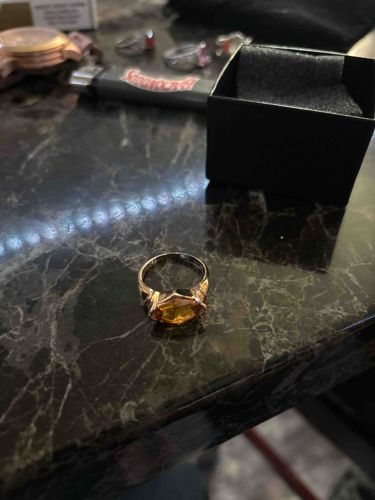
The item is a ring featuring a prominent faceted orange or yellow gemstone, likely a citrine or a similar quartz variety, set in a gold-toned metal band. The central stone is octagonal or cushion-cut, with visible facets that reflect light, suggesting a transparent to translucent quality. The setting appears to be a bezel or semi-bezel style, securely holding the stone. The band of the ring is relatively wide and seems to have some decorative elements, possibly an engraved or textured pattern on the shoulders leading up to the gem. The metal exhibits a warm, golden hue, which could be yellow gold, gold-plated, or gold-filled. There are no obvious signs of significant wear or damage to the stone, such as chips or abrasions, and the metal appears to be in good condition with a polished finish, though minor surface scratches typical of wear might be present but are not clearly discernible from the image. The ring size is not apparent, but it appears to be a standard adult size. Without clearer views or hallmarks, manufacturing details like maker's marks or specific metal content cannot be determined. The design suggests a contemporary or classic style, likely from the late 20th to early 21st century. The overall craftsmanship appears solid, providing a secure and aesthetically pleasing setting for the central gem.
AI Appraisal Report
I have carefully examined the provided image of the Gold-Toned Ring with Octagonal Orange/Yellow Gemstone. From my visual assessment, the ring appears to be in good overall condition. The central gemstone, likely a citrine or a similar quartz, is well-faceted and shows good light reflection, suggesting transparency. I do not observe any significant chips or abrasions on the stone. The gold-toned metal band appears polished and free from major damage, though minor surface scratches typical of wear are always possible and not discernible from this image.
Authenticity: Based solely on the image, I can confirm the item's apparent form and design match the description. However, definitive authentication of the metal content (e.g., solid gold versus plated/filled) and precise gemstone identification (natural vs. synthetic, specific quartz variety) cannot be made without in-person examination. Hallmarks are not visible, preventing straightforward identification of the maker or precise metal purity. Without physical inspection, I cannot rule out the possibility of it being costume jewelry, although its appearance suggests finer quality.
Market Conditions & Comparables: The market for classic or contemporary rings featuring prominent colored gemstones is consistently stable. Similar rings with genuine citrine set in 10k or 14k gold can range significantly in value. Rings with gold plating or lower quality metals would fetch considerably less.
Demand & Rarity: Citrine is a popular and relatively common gemstone, so this particular item is not exceptionally rare. Demand for such rings is moderate, especially for those seeking an attractive, non-diamond statement piece.
Factors Impacting Value: The primary factors impacting value are the actual metal content (solid gold versus plated), the gemstone's authenticity and precise identification (e.g., natural citrine of good clarity and cut), and the overall craftsmanship. The security of the setting and lack of damage are positive factors. Without physical examination, the most significant limitation is determining if the metal is solid gold or gold-filled/plated, and confirming the gemstone's precise identity and whether it is natural or synthetic. An in-person examination would require a jeweler's loupe, specific gravity testing for the stone, and potentially acid testing or XRF analysis for the metal. Provenance documentation (e.g., original sales receipts, gemological certificates) would also greatly assist in full authentication and valuation.