These notes were written by the person who submitted this item. Appraiser.AI has not verified them, and the AI's identification and estimate may rely on them.
AI Estimated Value
Not an official valuation
$600 - $900
AI estimate as of December 4, 2025 · verify with a professional before acting
AI-Generated · Verify before acting
Everything on this page is generated by AI for informational purposes only. AI can make mistakes — the AI may misidentify items or misattribute them (artist, maker, brand, designer, origin, era). This is not an official valuation and should not be used for insurance, sale, tax, estate, legal, or lending purposes — or any decision requiring a certified appraisal. It is not an authoritative claim about any person, brand, or rights holder — do not share or rely on it as a factual statement about a third party. Always consult qualified professionals before making financial decisions.
This analysis also relies on unverified notes provided by the user, which may be incomplete or inaccurate and could affect the result.
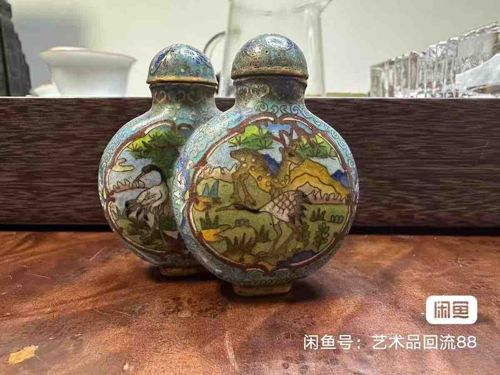
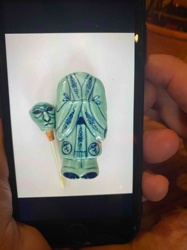
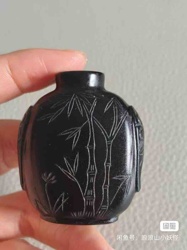
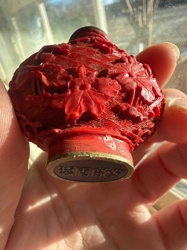
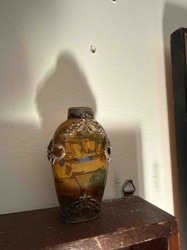
This is a pair of antique cloisonné enamel snuff bottles, each distinctive yet clearly part of a set. They are characterized by their rounded, flattened ovoid bodies and domed caps, typical for snuff bottles. The primary material appears to be brass or bronze, meticulously decorated with cloisonné enamelwork. The color palette is rich and varied, predominantly featuring shades of green, blue, yellow, and brown, with accents of red and white. Each bottle showcases an intricate landscape scene on its main body, framed by a patterned border near the neck and base. One bottle depicts a crane-like bird amidst foliage and water, while the other features a deer-like animal grazing in a mountainous landscape. The background enamel on both bottles is a light, perhaps sky-blue or faded green, speckled with tiny darker dots, indicating a speckled or sanded ground technique often seen in older cloisonné. The enamel cells are defined by thin metal wires, which show some oxidation and patination consistent with age. There are visible signs of wear and tear, including minor surface abrasions, small losses to the enamel in places, and a general dulling of the original luster due to extensive handling and environmental exposure over time. The metal fittings, particularly the caps, exhibit significant patination and some verdigris, suggesting an aged copper-based alloy. The craftsmanship appears to be of good quality, with fine details discernible in the wirework, suggesting a skilled artisan. Based on the style and discernible techniques, these bottles likely date from the late 19th to early 20th century, probably from China, a period well-known for its elaborate cloisonné production. The naturalistic depictions and traditional enamel techniques point to a classic aesthetic. Unique aspects include the pairing and the slight variations in design, typical of handmade sets.
AI Appraisal Report
Upon examining the images of this pair of cloisonné enamel snuff bottles, I can provide a preliminary appraisal based on their visual characteristics. The bottles appear to be authentic late Qing Dynasty to early Republic period (circa late 19th to early 20th century) Chinese artifacts. My assessment is based on the style of the cloisonné, the naturalistic landscape motifs featuring a crane and a deer (symbols of longevity and prosperity), the form of the bottles, and the visible signs of age, such as the natural patination on the metalwork and minor losses to the enamel. The craftsmanship, particularly the fine wirework, suggests a high level of skill.
The market for Chinese antiques, especially snuff bottles, remains robust. Paired bottles are rarer than single examples and are more desirable to collectors, which significantly increases their value. The condition, showing expected wear and tear but no major catastrophic damage, is acceptable for items of this age. However, factors negatively impacting the value include the minor enamel losses and surface abrasions.
Comparable pairs of good quality cloisonné snuff bottles from this period typically sell in the $600 to $900 range at auction, depending on the venue and specific collector interest. The distinct yet complementary designs of this pair make them a particularly attractive set.
It is crucial to note that this appraisal is limited by the inability to conduct a physical examination. For full authentication, I would need to handle the bottles to assess their weight and balance, examine the interior and footrim for tool marks, and use a jeweler's loupe to inspect the enamel and wirework more closely. Provenance documentation or scientific analysis of the metal and enamel composition would further solidify authenticity and could potentially increase the value.