AI Appraisal Estimate

AI-generated estimates · not official valuations

From the user

What was submitted

Photo and notes provided by the user — not generated by AI

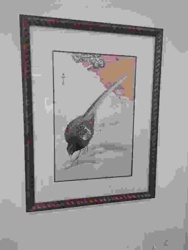
Submitted item photo
Submitted photo · May 18, 2026

User's notes

No additional notes provided.

AI analysis below

AI appraisal

AI analysis & estimate

AI-Generated · Verify before acting

Everything below is generated by AI for informational purposes only. AI can make mistakes — the AI may misidentify items or misattribute them (artist, maker, brand, designer, origin, era). This is not an official valuation and should not be used for insurance, sale, tax, estate, legal, or lending purposes — or any decision requiring a certified appraisal. It is not an authoritative claim about any person, brand, or rights holder — do not share or rely on it as a factual statement about a third party. Always consult qualified professionals before making financial decisions.

Read the full disclaimer

AI Identification

·Not independently authenticated·Verify before acting

The Great Wave off Kanagawa by Katsushika Hokusai

Fine Art - Asian Prints

AI Estimated Value

·Not an official valuation·Verify before acting

$150 - $300

As of May 18, 2026

AI Item Analysis

·AI can make mistakes·Verify before acting
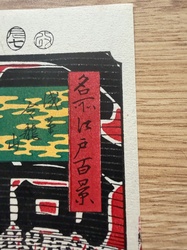
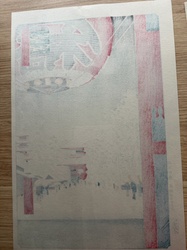
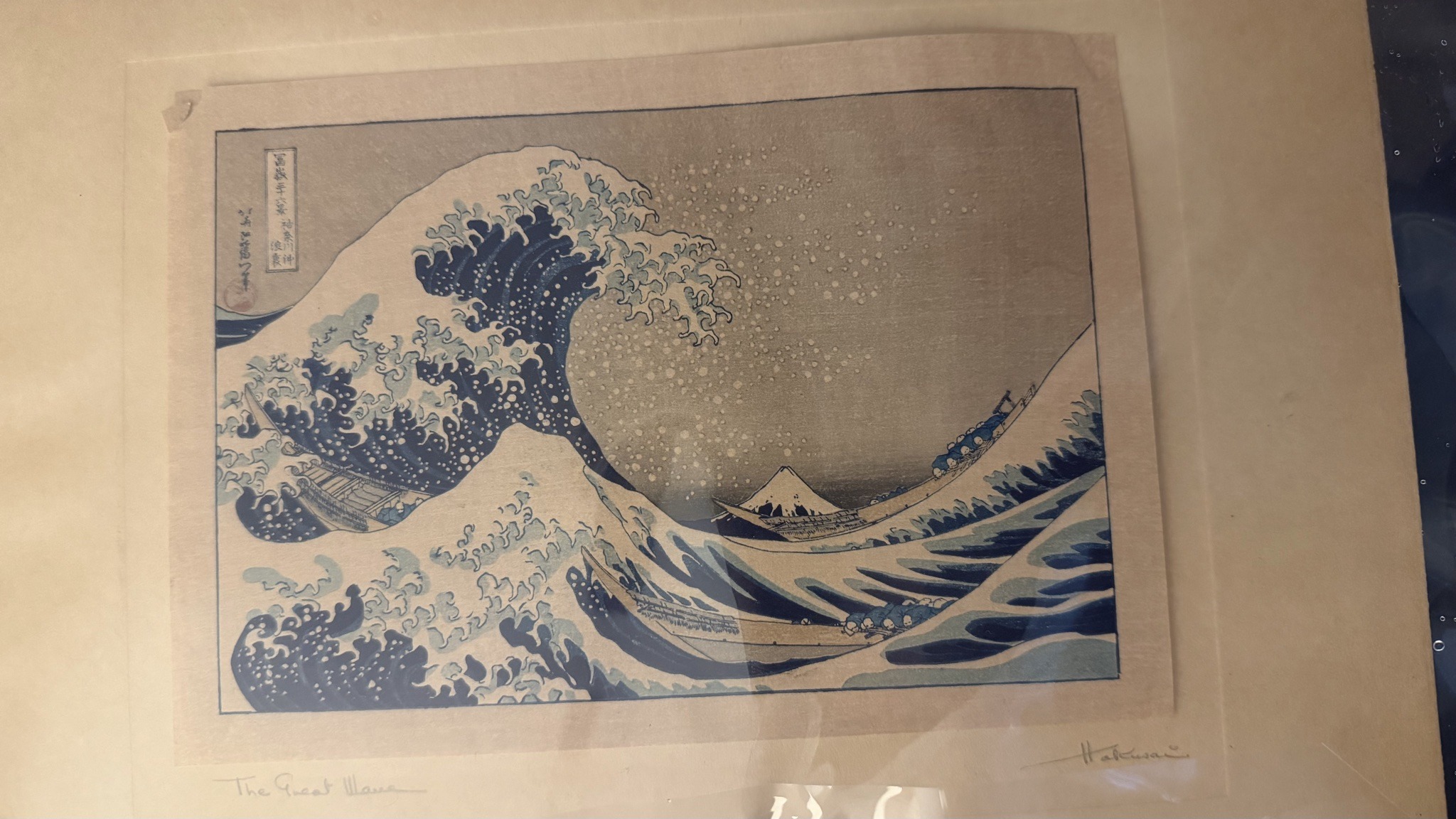
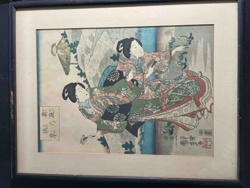
This item is a woodblock print after the iconic ukiyo-e work titled 'The Great Wave off Kanagawa' from the series 'Thirty-six Views of Mount Fuji' by the Japanese artist Katsushika Hokusai. The image depicts an enormous, cresting 'rogue wave' threatening three oshiokuri-bune boats, with Mount Fuji visible in the background against a stylized sky. The color palette features varying shades of indigo and Prussian blue, contrasted against the off-white foam and a neutral grey sky. Noteworthy details include the cartouche in the upper-left corner containing the Japanese title and signature. The paper appears to be an aged, textured washi-style paper, currently housed within a cream-colored mat. Condition-wise, the paper shows overall yellowing and tonal inconsistencies consistent with age or light exposure. There is a visible pencil inscription in the lower margin reading 'The Great Wave' on the left and a 'Hokusai' signature on the right, which suggests this is a later 20th-century reproduction or commemorative printing rather than a first-state Edo period strike. The print quality shows clear lines and defined gradients, though it lacks the specific bokashi (color gradation) subtleties found in early museum-grade impressions. The framing includes a protective glass layer which shows surface reflections.
AI Appraisal Report

·AI can make mistakes·Verify before acting
Upon visual examination of this print after Katsushika Hokusai’s 'The Great Wave off Kanagawa,' I have determined it to be a mid-to-late 20th-century decorative reproduction. The presence of a graphite pencil inscription in English ('The Great Wave') and the Western-style 'Hokusai' signature in the lower margin are definitive indicators that this is a commemorative or commercial edition rather than an original Edo-period impression. The palette uses Prussian blue adequately, but the lack of subtle hand-application in the bokashi (gradation) and the uniform yellowing of the paper suggest a later mechanical or woodblock-after-copy process. The market for mid-century reproductions of ukiyo-e masterpieces is robust but price-capped. While an original 1831 impression can command over $500,000, secondary market sales for later editions typically fall in the low hundreds. High-quality Takamizawa or Adachi woodblock reproductions can reach higher values, but the specific pencil markings here suggest a more common commercial printing. Current demand remains high due to the image's iconic status, though the visible tonal inconsistencies and light damage in the upper margins slightly detract from the value. Limitations: This appraisal is based solely on digital images. A definitive valuation would require an in-person inspection to examine the paper’s versos for ink penetration, verify the presence of woodblock registration marks (kento), and identify specific publisher seals. Scientific fiber analysis or UV-fluorescence testing would be necessary if there were any claim of earlier origin, though the inscriptions and paper texture essentially confirm its status as a decorative after-market print.

Get your items appraised

Instant estimates of your treasures with AI-powered appraisals

Browse More Appraisals