AI Appraisal Estimate

AI-generated estimates · not official valuations

From the user

What was submitted

Photo and notes provided by the user — not generated by AI

Submitted item photo
Submitted photo · May 27, 2026

User's notes

1900-2000

AI analysis below

AI appraisal

AI analysis & estimate

AI-Generated · Verify before acting

Everything below is generated by AI for informational purposes only. AI can make mistakes — the AI may misidentify items or misattribute them (artist, maker, brand, designer, origin, era). This is not an official valuation and should not be used for insurance, sale, tax, estate, legal, or lending purposes — or any decision requiring a certified appraisal. It is not an authoritative claim about any person, brand, or rights holder — do not share or rely on it as a factual statement about a third party. Always consult qualified professionals before making financial decisions.

Note

This analysis also relies on unverified notes provided by the user, which may be incomplete or inaccurate and could affect the result.

Read the full disclaimer

AI Identification

·Not independently authenticated·Verify before acting

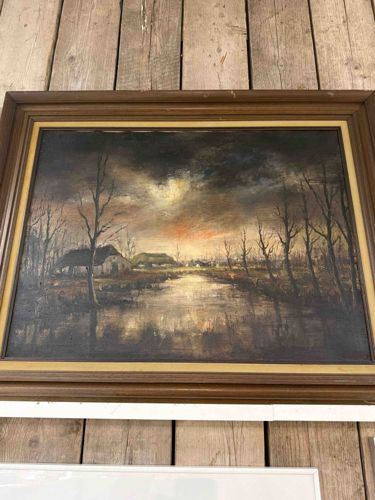
Dutch School Tonalist Landscape Oil Painting

Fine Art - Paintings

AI Estimated Value

·Not an official valuation·Verify before acting

$450.00 - $700.00

As of May 27, 2026

AI Item Analysis

·AI can make mistakes·Verify before acting
This is a horizontal oil painting on canvas, likely dating from the mid-20th century (circa 1930-1960), though depicting a scene in a traditional 19th-century Dutch Tonalist style. The composition features a moody, low-light landscape with a winding river or canal in the foreground, reflecting a partially obscured sun or moon through heavy, turbulent clouds. To the left, a traditional thatched-roof cottage is nestled among leafless, spindly trees that suggest a late autumn or winter setting. The color palette is dominated by deep earth tones, including umber, sienna, and dark ochre, contrasted by a central glow of yellow and orange light on the horizon. The application of paint appears thick with visible brushwork, contributing to a sense of texture and atmospheric depth. The artwork is housed in a wide, multi-tiered dark wood frame with a gilded inner liner. Condition-wise, the frame shows several prominent scuffs and scratches along the upper horizontal member, and the canvas surface appears to have a layer of aged varnish that has darkened slightly over time. No signature is clearly visible in the lower registers, which is common for regional European works of this era intended for the decorative market. The craftsmanship reflects a skilled hand familiar with light-play and reflection techniques.

AI Appraisal Report

·AI can make mistakes·Verify before acting
I have completed a visual examination of this mid-20th-century landscape. The work is a prototypical example of the 'New Hague School' influence, where artists utilized Tonalist aesthetics to meet the high decorative demand for nostalgic rural scenes. The execution of the 'luminary' effect—the reflection of the sun on the water—shows a high level of technical competency. However, the lack of a visible signature and the presence of darkened varnish suggest a commercial origin rather than a specific 'Master' work. The frame, while substantial, shows significant abrasions that require professional refinishing. The market for mid-century European landscapes is currently steady but saturated. Comparables for unsigned Dutch-style works of this size typically hammer at auction between $300 and $600, with retail gallery prices reaching the $1,200 range if restored. The current valuation reflects the 'as-is' condition, accounting for the cost of surface cleaning and frame repair. Limitations of this appraisal include the inability to inspect the verso for canvas stamps, gallery labels, or stretcher construction which could more precisely date the piece. Authenticity as a 19th-century period piece is unlikely given the impasto technique and pigment density visible; however, a definitive age could only be established through a physical inspection of the craveure patterns and a UV fluorescence test to check for overpainting. To finalize a formal insurance appraisal, I would require provenance documentation or a physical inspection to rule out mass-produced 'factory' origins common in the post-WWII era.

Get your items appraised

Instant estimates of your treasures with AI-powered appraisals

Browse More Appraisals