AI estimate as of August 2, 2025 · verify with a professional before acting
AI-Generated · Verify before acting
Everything on this page is generated by AI for informational purposes only. AI can make mistakes — the AI may misidentify items or misattribute them (artist, maker, brand, designer, origin, era). This is not an official valuation and should not be used for insurance, sale, tax, estate, legal, or lending purposes — or any decision requiring a certified appraisal. It is not an authoritative claim about any person, brand, or rights holder — do not share or rely on it as a factual statement about a third party. Always consult qualified professionals before making financial decisions.
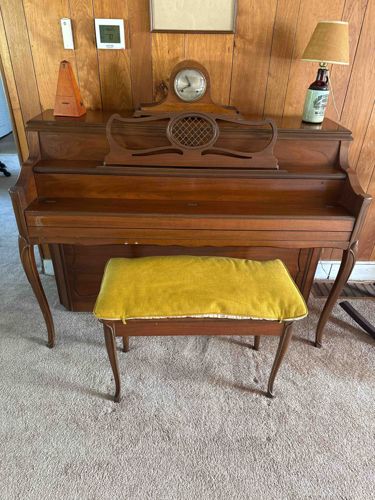
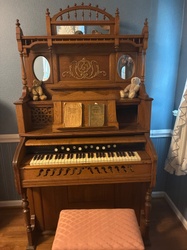
The item is an upright piano, likely a spinet or console model, crafted from a warm-toned, reddish-brown wood, possibly mahogany or a similarly stained hardwood, exhibiting a rich grain. Its overall aesthetic suggests a mid-20th-century design, possibly from the Art Deco or Mid-Century Modern period, judging by the decorative elements. The piano features ornate, carved legs with a subtle cabriole-like curve, providing a graceful stance. The top portion of the piano incorporates a decorative fascia or music stand, characterized by a central oval element with a criss-cross or lattice-like grillwork, flanked by elegantly scrolled or curved woodworking. A small, round clock with a white face and black numerals is inset into the top center of this decorative panel, a common feature on pianos from certain eras designed to integrate functionality and aesthetics. The wood finish displays a visible sheen, suggesting it has been cared for, though minor surface wear consistent with age and use, such as light scratches or nicks, might be present upon closer inspection. The corresponding piano bench, made from the same wood, features a plush, bright yellow (chartreuse or mustard yellow) velvet or similar fabric cushion, indicating a reupholstering or a deliberate choice for a pop of color. The bench legs mirror the curved style of the piano, creating a cohesive set. No obvious structural damage like major cracks or breaks is immediately apparent from the image, but the condition of the internal components (keys, hammers, strings) cannot be assessed visually. The overall craftsmanship appears solid, indicative of a mass-produced but well-made instrument of its time.
AI Appraisal Report
Upon visual examination of the provided image, I assess this upright piano with integrated clock and matching bench. The instrument appears to be a spinet or console model, crafted from a reddish-brown hardwood, likely mahogany, exhibiting a warm finish and prominent grain. The design strongly suggests a mid-20th-century origin, possibly between the 1940s and 1960s, aligning with the integrated clock feature and the decorative, curvilinear elements. The carved legs and the distinctive oval fascia with lattice-work contribute to its aesthetic appeal. The wood finish shows a visible sheen, indicating reasonable care over time, though minor surface wear such as light scratches or nicks are to be expected given its age. Structural integrity of the wood appears good, with no obvious cracks or breaks. The matching bench, upholstered in a bright yellow velvet, is a cohesive and visually striking element of the set.
In terms of market conditions, pianos of this age and type are generally abundant. Their value is heavily influenced by their playability, internal condition, and brand reputation, None of which can be determined from an image. While the exterior condition is pleasing, the primary demand for such instruments today is often weighted more towards decorative or furniture pieces rather than high-performance musical instruments, unless it is a premium brand fully restored. The integrated clock adds a unique, charming characteristic, which could slightly enhance its decorative appeal. However, the rarity is not significant; many manufacturers produced similar models during this period. Without an in-person examination to assess the internal mechanisms (keys, hammers, soundboard, strings, pedals) and confirm brand, model, and serial number, the true functional value remains speculative. Provenance documentation, if available, could confirm its history and potentially identify a notable manufacturer, which would impact authenticity and value. Therefore, this appraisal is limited to the visual presentation. A physical inspection by a piano technician would be essential to determine its musical functionality and precise structural integrity.