These notes were written by the person who submitted this item. Appraiser.AI has not verified them, and the AI's identification and estimate may rely on them.
AI Estimated Value
Not an official valuation
$75 - $125
AI estimate as of November 12, 2025 · verify with a professional before acting
AI-Generated · Verify before acting
Everything on this page is generated by AI for informational purposes only. AI can make mistakes — the AI may misidentify items or misattribute them (artist, maker, brand, designer, origin, era). This is not an official valuation and should not be used for insurance, sale, tax, estate, legal, or lending purposes — or any decision requiring a certified appraisal. It is not an authoritative claim about any person, brand, or rights holder — do not share or rely on it as a factual statement about a third party. Always consult qualified professionals before making financial decisions.
This analysis also relies on unverified notes provided by the user, which may be incomplete or inaccurate and could affect the result.
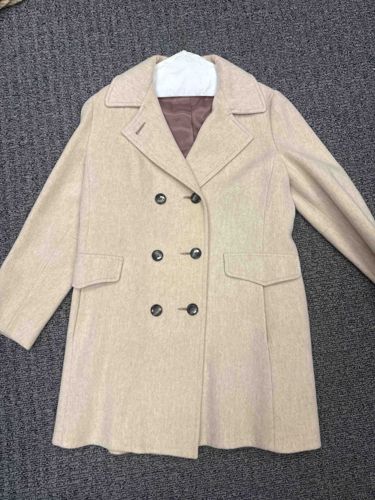
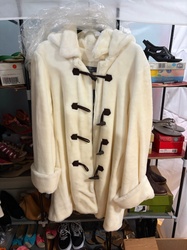
This is a sophisticated women's jacket, styled akin to a peacoat, primarily in a versatile beige or light tan color. It features a classic double-breasted front closure with four prominent dark-colored buttons, arranged in two vertical rows, and two smaller, likely decorative or functional, buttons on the upper lapel. The fabric appears to be a wool or wool-blend material, evidenced by its slightly napped, textured finish, suggesting warmth and durability. The jacket has a tailored silhouette, extending to approximately mid-thigh length. It boasts a wide, notched lapel collar, characteristic of traditional peacoats. Two flapped patch pockets are visible on the front at hip level. The sleeves are full-length and appear to have a straight cut. The interior lining is a contrasting deep brown or reddish-brown, possibly a satin or polyester blend, indicating a finished garment with attention to interior detail. The overall construction suggests a well-made garment, likely from the mid to late 20th century, given the classic cut. There are no obvious signs of significant wear, tears, or damage visible in the provided images, indicating it is in good pre-owned or possibly new condition. The seams appear neatly stitched, and the buttons are securely attached. The subtle marled texture of the fabric adds depth to its appearance.
AI Appraisal Report
I have examined the provided image of this women's double-breasted peacoat-style jacket. The jacket presents in what appears to be good pre-owned condition, with no visible signs of significant wear, tears, or damage from the image. The tailoring seems classic, suggesting a well-constructed garment. The fabric, likely a wool or wool-blend, exhibits a textured finish, contributing to its durability and warmth.
Authenticity is difficult to ascertain fully from images alone. While the style is classic, confirming the material composition (e.g., specific wool percentage), brand, and manufacturing origin would require an in-person examination. Physical inspection would allow me to assess the quality of stitching, check for brand labels, care tags, and fabric feel, which are crucial for a definitive authenticity statement. Without physical inspection, I cannot verify if this is a high-end designer piece or a well-made contemporary item. The age, noted as potentially mid to late 20th century, is an estimate based on the classic cut.
Considering market conditions for similar pre-owned classic-style wool blend peacoats, demand is generally moderate. While a peacoat is a timeless style, this particular jacket does not exhibit features that suggest high rarity or exceptional designer value without further identification. Factors impacting value include its classic style, apparent good condition, and versatile color. However, the lack of a discernible brand in the image limits its potential for a higher valuation.
Given these considerations, and cautiously assuming it is a good quality, unbranded or mid-range brand garment, I would place its current market value, in its present condition, in the range of $75 to $125. A full authentication would necessitate an in-person physical examination to inspect labels, fabric composition, and overall craftsmanship, which could potentially adjust this valuation.