These notes were written by the person who submitted this item. Appraiser.AI has not verified them, and the AI's identification and estimate may rely on them.
AI Estimated Value
Not an official valuation
$75-150
AI estimate as of November 15, 2025 · verify with a professional before acting
AI-Generated · Verify before acting
Everything on this page is generated by AI for informational purposes only. AI can make mistakes — the AI may misidentify items or misattribute them (artist, maker, brand, designer, origin, era). This is not an official valuation and should not be used for insurance, sale, tax, estate, legal, or lending purposes — or any decision requiring a certified appraisal. It is not an authoritative claim about any person, brand, or rights holder — do not share or rely on it as a factual statement about a third party. Always consult qualified professionals before making financial decisions.
This analysis also relies on unverified notes provided by the user, which may be incomplete or inaccurate and could affect the result.
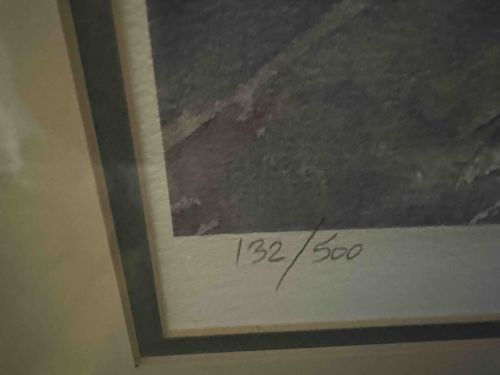
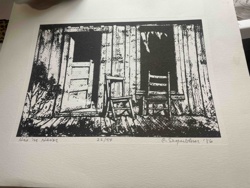
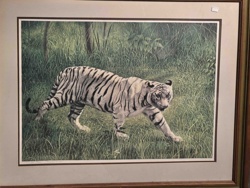
The item is a framed limited edition print, visible through its lower right quadrant. The print itself appears to depict a landscape or natural scene, characterized by dark, muted tones, possibly greens and grays, suggesting foliage or rocky terrain. The primary focus of the visible area is the off-white matting surrounding the print, which features a handwritten inscription in black marker or pen: '132/500'. This inscription clearly indicates that the print is part of a limited edition run, specifically the 132nd print out of a total edition of 500. The print is housed within a frame, with a dark-colored border, likely black or dark brown, delineating the edge of the matting and the print itself. The frame itself has a wider outer edge, appearing to be a dark, possibly wooden or metal, molding. The lighting in the image suggests an indoor setting, with some glare on the protective glass or acrylic covering the print. No artist signature or specific title is discernible from the provided image. The overall condition appears good from the limited view, with no obvious tears, creases, or significant discoloration to the print or matting. The craftsmanship of the framing seems standard, providing a protective and presentable display for the artwork. The limited edition numbering implies a certain level of artistic and commercial intent, often correlating with giclée prints, lithographs, or etchings. Without further visual information of the artwork itself, precise style, age, or manufacturing details beyond the edition size remain speculative.
AI Appraisal Report
I have examined the provided image of this framed limited edition print. My assessment indicates a good overall condition based on the visible lower right quadrant, showing no obvious damage to the print or matting. The handwritten inscription '132/500' on the off-white matting clearly establishes its authenticity as a limited edition piece. This numbering system is standard practice for limited edition prints, indicating the specific print number and the total edition size. The print itself, partially visible, appears dark and muted, suggestive of a landscape or natural scene, but specific artistic style or subject matter cannot be definitively determined from this limited view. The framing appears standard and protective.
Market conditions for an unidentified limited edition print, especially without a known artist or title, are highly dependent on its aesthetic appeal and the reputation of the artist. Without this crucial information, demand and rarity are challenging to assess accurately. While the limited edition aspect creates inherent rarity (1 of 500), the lack of artist provenance significantly limits its market appeal and collectible value. Comparable items in this category—unidentified limited edition prints without artist signatures or titles—typically fetch modest prices, primarily reflecting the decorative value rather than artistic merit or investment potential.
Factors significantly impacting value here are primarily the unknown artist, title, and detailed visual of the artwork. The current value is largely based on its decorative potential and the fact that it is a limited edition. For full authentication and a more precise valuation, an in-person examination would be necessary to assess the print's specific medium (e.g., giclée, lithograph, etching), the quality of the paper, and to closely inspect for any artist signatures or chop marks not visible in the image. Provenance documentation, such as a certificate of authenticity or artist’s biography, would also be critical for a confident assessment of its artistic and market value. Without these, the appraisal remains speculative regarding its artistic significance.