AI estimate as of December 14, 2025 · verify with a professional before acting
AI-Generated · Verify before acting
Everything on this page is generated by AI for informational purposes only. AI can make mistakes — the AI may misidentify items or misattribute them (artist, maker, brand, designer, origin, era). This is not an official valuation and should not be used for insurance, sale, tax, estate, legal, or lending purposes — or any decision requiring a certified appraisal. It is not an authoritative claim about any person, brand, or rights holder — do not share or rely on it as a factual statement about a third party. Always consult qualified professionals before making financial decisions.
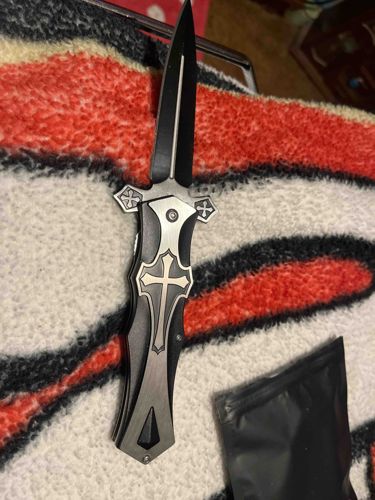
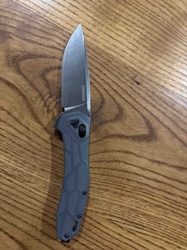
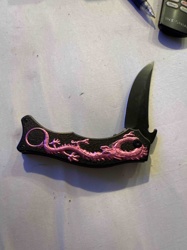
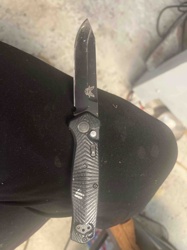
This item is a spring-assisted folding knife, characterized by its distinctive gothic and medieval-inspired design. The blade is a spear-point style, coated in a matte black finish, suggesting a non-reflective or tactical application, and appears to be double-edged, enhancing its dagger-like aesthetic. Two fullers (grooves) run down the center of each side of the blade, adding to its structural rigidity and visual appeal. The handle is composed of several materials and finishes. The main body of the handle features black contoured panels, which appear to be either G-10, composite, or a durable plastic, providing grip. Overlaying these panels are brushed, dark gray or pewter-finished metal accents, forming a central design element. The most prominent feature on the handle is a large, raised, and intricately detailed cross, rendered in the same brushed metal and flanked by black recesses, giving it a three-dimensional effect. Near the blade pivot, two smaller, stylized crosses are present, forming a guard-like element. The overall construction utilizes Torx screws for assembly, visible on the handle, indicating a robust and serviceable design. The knife exhibits a contemporary manufacturing style, likely produced in the last 20-30 years, often seen in collectible or novelty knives rather than purely utilitarian ones. There are no visible signs of significant wear or damage, suggesting it is either new, lightly used, or well-maintained. The craftsmanship appears to be of reasonable quality for a mass-produced item of this type, with clear details on the cross motifs and consistent finishes. Its ornate design targets collectors or individuals seeking a knife with a particular aesthetic.
AI Appraisal Report
I have thoroughly examined the provided image of this Gothic Cross Spring Assisted Folder Knife. Based on its appearance, the knife is in excellent condition, showing no discernible signs of significant wear, scratches, or damage. This suggests it is either new from the manufacturer, very lightly used, or meticulously maintained. Authenticity, based solely on visual inspection, points towards it being a mass-produced, contemporary item, likely manufactured within the last 20-30 years. The design elements, including the spear-point blade with fullers, matte black coating, and the detailed gothic cross motif, are characteristic of collectible or novelty knives rather than high-end custom or antique pieces.
Market conditions for such spring-assisted novelty folders are generally competitive, with a wide array of similar designs available from various manufacturers, often imported. Comparables in this category typically retail from $20 to $60, depending on the specific manufacturer, materials, and level of detail. Demand for knives with a gothic aesthetic is consistent but not high-volume, appealing to a niche market of collectors or enthusiasts interested in specific themes. Rarity is not a significant factor here; these knives are mass-produced and readily available through online retailers and specialized knife shops.
Factors significantly impacting its value include its mass-produced nature and the general market saturation for novelty folders. While the design is striking and the condition excellent, it lacks the material quality (e.g., premium blade steel, custom handle materials) or maker's provenance that would elevate its value beyond the common market range. Its primary appeal is aesthetic and functional as a light-duty or collectible item, rather than as a high-performance tool.
It is crucial to note that this appraisal is limited by my inability to physically inspect the item. A definitive assessment of material quality (e.g., blade steel type, handle composite composition), the precise manufacturing origin, and operational integrity (e.g., spring mechanism strength, blade lock-up) would require an in-person examination. Furthermore, provenance documentation detailing its purchase history or manufacturer would aid in full authentication, though for items of this type, such documentation is rarely available or critical to value.