AI estimate as of August 20, 2025 · verify with a professional before acting
AI-Generated · Verify before acting
Everything on this page is generated by AI for informational purposes only. AI can make mistakes — the AI may misidentify items or misattribute them (artist, maker, brand, designer, origin, era). This is not an official valuation and should not be used for insurance, sale, tax, estate, legal, or lending purposes — or any decision requiring a certified appraisal. It is not an authoritative claim about any person, brand, or rights holder — do not share or rely on it as a factual statement about a third party. Always consult qualified professionals before making financial decisions.
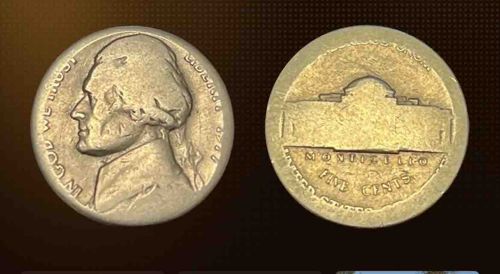
The item is a United States Jefferson Nickel, specifically the 1940-dated coin as indicated by the '1940' visible on the obverse. The coin exhibits a metallic silver-gray color on the obverse, with a more brassy or golden hue on the reverse, suggesting a possible difference in lighting or perhaps some toning/discoloration on the reverse side. The obverse features a profile portrait of Thomas Jefferson facing left, with the inscription "IN GOD WE TRUST" along the left rim and "LIBERTY" and the date "1940" on the right rim. The details of Jefferson's hair and facial features appear to be somewhat worn but are largely discernible. The reverse depicts Monticello, Jefferson's primary plantation, with "MONTICELLO" inscribed above the building and "FIVE CENTS" below it. "UNITED STATES OF AMERICA" is visible along the bottom rim. There's visible wear on both sides, particularly on the higher points of the relief such as Jefferson's cheekbone and hair, and the dome of Monticello. The rim on both sides shows some unevenness and signs of circulation wear, with some minor dings or imperfections. There are no obvious signs of major damage like deep scratches or repairs, but the overall appearance suggests it has been in active circulation for an extended period, leading to a smooth patina rather than sharp details. The craftsmanship is typical of US coinage of this era, designed for mass production, yet retaining a recognizable artistic quality. The material is likely the standard copper-nickel alloy used for nickels, though the color variation in the image is noteworthy.
AI Appraisal Report
I have examined the provided image of the 1940 Jefferson Nickel. Based on the visual evidence, the coin appears to be an authentic U.S. Jefferson Nickel from 1940. The date, '1940', and the primary design elements of Jefferson on the obverse and Monticello on the reverse, are consistent with known specimens of this mintage. The obverse shows 'IN GOD WE TRUST' and 'LIBERTY' with the date, while the reverse has 'MONTICELLO', 'FIVE CENTS', and 'UNITED STATES OF AMERICA', all standard features.
From the image, the condition is definitively 'Circulated'. There is noticeable wear on both sides, particularly on the high points such as Jefferson's cheekbone, hair, and the dome of Monticello. The lettering and details, though discernible, show softening due to circulation. The rims exhibit dings and wear, consistent with decades of handling. The color variation, with the reverse appearing more brassy, is likely due to toning or environmental exposure rather than a different alloy. This level of wear places it in a Good (G) to Very Good (VG) grade range, without being able to hold the coin in hand to confirm. Minor surface imperfections are also visible.
In terms of market conditions, 1940 Jefferson Nickels are not considered rare. They were widely minted, and a significant number remain in circulation or in collections. Demand for circulated examples like this is generally low among serious collectors, who tend to seek uncirculated or higher-grade specimens. The value is primarily driven by its face value plus a small collector premium for common dates in low grades. Unless it possesses an error or variety not visible from the image (which is very unlikely given the wear), it's a common coin.
To definitively authenticate this coin and assess its grade precisely, a physical, in-person examination would be required. This would allow for proper inspection under magnification, assessment of luster, surface integrity, potential hidden damage, and edge condition, which are critical for accurate grading. Provenance documentation would not add significant value for a common circulated coin like this. Scientific testing would only be necessary to verify the metallic composition, which is generally not a concern for standard U.S. coinage unless a specific anomaly is suspected.
Given the common date and circulated condition, this coin holds minimal numismatic premium above its face value.