AI estimate as of September 22, 2025 · verify with a professional before acting
AI-Generated · Verify before acting
Everything on this page is generated by AI for informational purposes only. AI can make mistakes — the AI may misidentify items or misattribute them (artist, maker, brand, designer, origin, era). This is not an official valuation and should not be used for insurance, sale, tax, estate, legal, or lending purposes — or any decision requiring a certified appraisal. It is not an authoritative claim about any person, brand, or rights holder — do not share or rely on it as a factual statement about a third party. Always consult qualified professionals before making financial decisions.
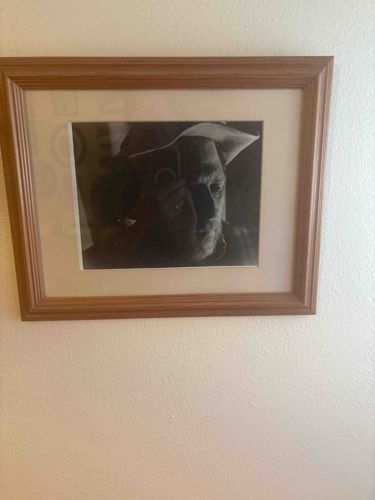
This item is a framed black and white photographic portrait of a man, likely a print, displayed within a light-colored wooden frame with a mat. The portrait itself is a close-up, focusing on the man's face, which appears to be rugged and possibly aged, with visible stubble or a short beard. He is wearing what appears to be a wide-brimmed hat, possibly a cowboy hat or a similar style, with one side of the brim clearly visible and angled upwards. The man's gaze is directed slightly off-camera to the right, and his expression seems pensive or intense. The lighting in the photograph creates strong contrasts, with significant shadowing on portions of his face, particularly around the eyes and nose, enhancing the dramatic effect. There is a detail that looks like a ring or a loop held near his face, possibly a pair of spectacles or another object, which is partially obscured by the shadow and the composition. The photograph exhibits good tonal range for a black and white print. The frame is made of wood, likely stained an oak or light walnut color, featuring a simple, classic profile with a slightly raised outer edge and a smooth flat inner edge. The matting surrounding the photograph is a neutral, light color, possibly off-white or cream, providing a visual separation between the image and the frame. The overall condition appears good with no obvious signs of damage to the frame or the print from the visible angle. This piece represents a common style of portraiture, suggesting a contemporary or modern aesthetic, potentially from the late 20th or early 21st century. The craftsmanship of the frame is functional and straightforward, lending itself to a mass-produced product rather than a bespoke, artisanal piece.
AI Appraisal Report
Upon examining the provided image of the Framed Black and White Portrait of a Man, I assess the condition of both the print and the frame to be good. There are no visible signs of damage, such as scratches, tears, or significant discoloration. Authenticity, however, is limited to visual assessment; from the image alone, it is not possible to verify if this is an original photographic print or a reproduction. The print exhibits good tonal range for a black and white photograph, and the dramatic lighting enhances its aesthetic appeal.
Market conditions for contemporary portraiture of this style, particularly from uncredited photographers, are generally modest. While the subject's rugged appearance and pensive expression are compelling, the lack of artist provenance or specific historical significance places it within a decorative art segment. Comparables tend to be mass-produced framed photographic prints available through home decor retailers or online art markets. Demand for such pieces is steady but not high, primarily driven by individuals seeking aesthetic accent pieces for their interiors rather than collectible artworks. Rarity is not a factor here; this style of portraiture is common, and given the functional, straightforward craftsmanship of the frame, it likely represents a widely available item rather than a unique artisanal product. The ring or loop detail is intriguing but doesn't significantly impact value without further context.
The primary factors impacting value are the lack of artist identification, the presumed absence of limited edition status, and the functional rather than artisanal frame. For a full authentication, in-person examination would be required to determine the print type (e.g., silver gelatin, inkjet), assess paper quality, and look for photographer's signatures or edition numbers. Provenance documentation could significantly elevate the value if it linked the piece to a known artist or a notable collection. Scientific testing, such as dating techniques for the paper or photographic process, would provide definitive answers regarding its age and authenticity. Without these, the appraisal reflects its value as a decorative, common photographic print.