AI estimate as of August 11, 2025 · verify with a professional before acting
AI-Generated · Verify before acting
Everything on this page is generated by AI for informational purposes only. AI can make mistakes — the AI may misidentify items or misattribute them (artist, maker, brand, designer, origin, era). This is not an official valuation and should not be used for insurance, sale, tax, estate, legal, or lending purposes — or any decision requiring a certified appraisal. It is not an authoritative claim about any person, brand, or rights holder — do not share or rely on it as a factual statement about a third party. Always consult qualified professionals before making financial decisions.
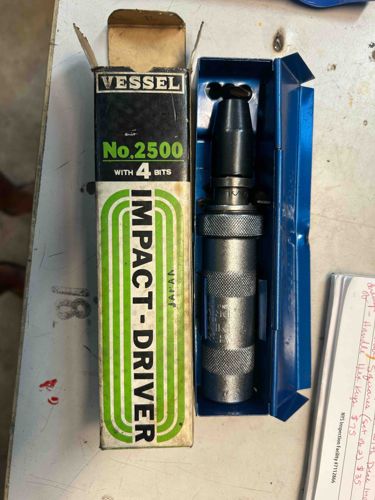
The item is a Vessel No. 2500 Impact Driver, presented in its original packaging. The packaging consists of a cardboard box with a black and white top section, featuring the "VESSEL" logo and the model number "No. 2500 WITH 4 BITS". The lower section of the box is predominantly white with green striped accents, and vertically printed text reading "IMPACT-DRIVER" and "JAPAN". The box shows signs of age and wear, including some creasing, discoloration, and minor tears, particularly on the top flaps. The impact driver tool itself is housed in a molded blue plastic or cardboard insert within the box. The tool appears to be constructed of dark gray or black metal, likely steel, with a heavily knurled cylindrical body for grip. The knurling extends over a significant portion of the tool's barrel. It has a robust, industrial aesthetic, typical of hand tools designed for heavy-duty use. The top portion of the tool, where the bits would be inserted, is a darker, possibly coated, metal. There are no obvious signs of significant damage like cracks or major deformities visible on the tool itself, although common wear from handling or light use, such as minor scuffs or worn finish, might be present. The inscription "JAPAN" on the box indicates its manufacturing origin. Given the style of the packaging and the tool's design, it likely dates from the mid to late 20th century, possibly 1970s or 1980s. The emphasis on '4 bits' suggests it originally came as a complete set, though the bits themselves are not visible in this image. Its overall condition, including the somewhat aged packaging, suggests it is either new old stock or very lightly used.
AI Appraisal Report
Upon my virtual examination of this Vessel No. 2500 Impact Driver with original packaging, I assess its condition as very good for its age. The tool itself appears robust and free from significant damage, retaining its industrial aesthetic. The knurled body suggests it's a solid, functional piece. The original packaging, while showing expected age and wear—creasing, discoloration, and minor tears—is largely intact, which significantly adds to its collector appeal. The 'MADE IN JAPAN' and 'VESSEL' branding, along with the distinctive packaging style, strongly support its authenticity as a vintage Vessel tool, likely from the 1970s or 1980s.
The market for vintage hand tools, especially those from reputable Japanese manufacturers like Vessel, shows consistent demand among collectors and tradespeople seeking quality and durability. Tools in their original packaging, particularly those appearing to be new old stock or very lightly used, command a premium due to their rarity and preserved state. Comparables for similar vintage Vessel tools, especially full sets, suggest a healthy interest. The absence of the advertised '4 bits' is a minor detractor; however, the excellent condition of the driver and packaging still makes it a desirable item.
Limitations to authenticity verification based on images alone exist. A physical inspection would allow me to assess the exact weight, the feel of the knurling, the functionality of the internal mechanism, and any subtle signs of use or repair not visible in photographs. Provenance documentation, such as original sales receipts, could further solidify its history. Scientific testing, while not typically applied to hand tools of this nature, could confirm the metallic composition if ever a doubt arose regarding the material quality.