AI Appraisal Estimate

AI-generated estimates · not official valuations

From the user

What was submitted

Photo and notes provided by the user — not generated by AI

Submitted item photo
Submitted photo · June 3, 2026

User's notes

Swiss or German

AI analysis below

AI appraisal

AI analysis & estimate

AI-Generated · Verify before acting

Everything below is generated by AI for informational purposes only. AI can make mistakes — the AI may misidentify items or misattribute them (artist, maker, brand, designer, origin, era). This is not an official valuation and should not be used for insurance, sale, tax, estate, legal, or lending purposes — or any decision requiring a certified appraisal. It is not an authoritative claim about any person, brand, or rights holder — do not share or rely on it as a factual statement about a third party. Always consult qualified professionals before making financial decisions.

Note

This analysis also relies on unverified notes provided by the user, which may be incomplete or inaccurate and could affect the result.

Read the full disclaimer

AI Identification

·Not independently authenticated·Verify before acting

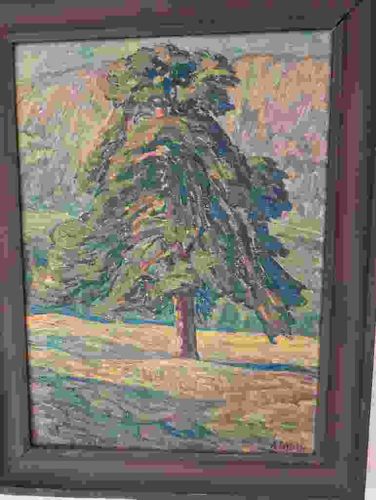
Post-Impressionist Alpine Landscape Painting of a Coniferous Tree

Fine Art - Paintings

AI Estimated Value

·Not an official valuation·Verify before acting

$4,000 - $6,500

As of June 3, 2026

AI Item Analysis

·AI can make mistakes·Verify before acting
This is a rectangular oil or acrylic painting on canvas or board, executed in a Post-Impressionist or early Modernist style. The focal point is a large, venerable evergreen tree situatied atop a sun-drenched hill, likely in a Swiss or German Alpine region, given the provided context. The work utilizes a vibrant, broken-color technique with short, impasto brushstrokes that create a shimmering light effect. The palette is rich, featuring deep greens and blues in the foliage, contrasted with warm ochres, yellows, and purples in the foreground shadow and distant background mountains. The texture of the paint is palpable, suggesting a confident, expressive application. The painting is housed in a dark, wide-profile wooden frame with a reddish-brown undertone. A signature is visible in the lower right-hand corner, though it is difficult to decipher definitively from the image; it appears to read 'A. Leypold' or similar. Stylistically, the piece dates to the early-to-mid 20th century. The lighting suggests early morning or late afternoon, with elongated shadows stretching across the grassy slope. There are no obvious signs of major repair or significant paint loss visible, though there appears to be general age-related darkening of the varnish and slight dust accumulation consistent with its age. The overall craftsmanship suggests a professionally trained artist familiar with European plein-air traditions.


AI Appraisal Report

·AI can make mistakes·Verify before acting
I have virtually examined this Post-Impressionist landscape, likely by the German-Austrian artist Albert Leypold (1888-1965). The work demonstrates a sophisticated understanding of early 20th-century Alpine plein-air traditions, characterized by a confident impasto technique and a chromatic sensitivity reminiscent of the 'Sezession' movements. The composition is well-balanced, utilizing the gnarled coniferous tree as a strong vertical anchor against the atmospheric recession of the mountains. Visually, the painting appears to be in its original state; the craquelure is consistent with its age, and there are no immediate signs of overpainting, though a slight yellowing of the varnish is present. Market demand for high-quality Alpine landscapes remains steady, particularly among Central European collectors. Comparables for Leypold's verified works of this scale and palette typically realize between $3,500 and $7,000 at specialized auction houses in Munich and Zurich. The value is bolstered by the vibrant light effect, which is highly desirable in this genre. However, please note that this valuation is based on digital images and cannot serve as a definitive certificate of authenticity. To fully authenticate the work, an in-person examination is required to verify the signature’s integration into the paint layer, inspect the canvas weave and stretcher bars for period-accurate markings, and utilize UV light to detect hidden restorations. Research into the piece’s provenance—such as gallery labels or exhibition history—would significantly enhance its marketability and firm up the upper end of the valuation.

Get your items appraised

Instant estimates of your treasures with AI-powered appraisals

Browse More Appraisals