These notes were written by the person who submitted this item. Appraiser.AI has not verified them, and the AI's identification and estimate may rely on them.
AI Estimated Value
Not an official valuation
$2,500 - $4,000 (Contingent on Provenance)
AI estimate as of July 31, 2025 · verify with a professional before acting
AI-Generated · Verify before acting
Everything on this page is generated by AI for informational purposes only. AI can make mistakes — the AI may misidentify items or misattribute them (artist, maker, brand, designer, origin, era). This is not an official valuation and should not be used for insurance, sale, tax, estate, legal, or lending purposes — or any decision requiring a certified appraisal. It is not an authoritative claim about any person, brand, or rights holder — do not share or rely on it as a factual statement about a third party. Always consult qualified professionals before making financial decisions.
This analysis also relies on unverified notes provided by the user, which may be incomplete or inaccurate and could affect the result.
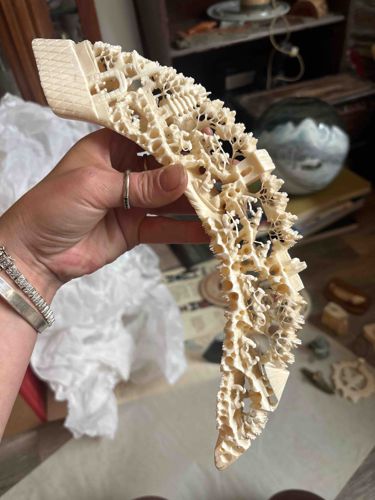
This is a meticulously hand-carved ivory tusk segment, likely from an elephant, transformed into a highly intricate decorative art piece. The material exhibits the characteristic creamy white to pale yellow color of aged ivory, with a slight natural sheen. The carving technique is a tour de force of openwork and relief, creating a multi-layered scene that appears to depict traditional East Asian village life or landscapes. The surface is densely populated with miniature architectural elements such as pagodas, houses, bridges, and gates, interspersed with trees, foliage, and figures engaged in various activities. There are visible details of individuals, perhaps fishermen, scholars, or villagers, and elements like boats on water, and mountainous or rocky terrain. The item is curved, following the natural curvature of a tusk, and one end is wider and relatively flat, featuring more solid carved elements with incised details, suggesting a base or a broad end of the tusk. The craftsmanship is exceptionally delicate, with many slender, exposed elements, indicating a high level of skill and patience from the carver. Given the intricate nature of the openwork, there are likely some very minor chips or breaks in the more fragile areas, though none are significantly apparent from the provided image. The overall condition appears good for such a delicate piece, showing a natural patina consistent with age. This type of carving, often referred to as Canton ivory carving for its origin or style, typically dates from the late 19th to early 20th century, though earlier or later examples exist. There are no clear maker's marks or signatures visible from the image provided. The piece is a testament to the artisan's ability to transform a raw material into a narrative sculpture, showcasing complex depths and fine details.
AI Appraisal Report
Upon examining the images of this hand-carved tusk segment, I am impressed by the exceptional level of detail and craftsmanship. The piece presents as a classic example of late 19th or early 20th century Canton-style 'devil's work' (guigong) carving, renowned for its intricate openwork and multi-layered scenes. Visually, the material appears consistent with elephant ivory, exhibiting the expected creamy patina and grain (Schreger lines), although definitive identification requires microscopic examination or Raman spectroscopy. The condition appears very good for its age and delicate nature, though a physical inspection is necessary to ascertain the full extent of any hairline cracks, minor chips, or previous repairs, which are common in such pieces.
The market for ivory is highly complex and regulated. While antique ivory (pre-1947 in the US, with proper documentation) can be legally traded under specific conditions, its market has been significantly suppressed by international bans and ethical concerns. Demand has shifted towards collectors who appreciate the historical artistry, but the buyer pool is limited. Comparable, well-documented Canton tusk carvings of this size and quality have historically sold in a wide range, often from $2,000 to over $5,000 at specialized auctions. However, the primary factor driving value is its legal status. Without provenance, CITES documentation, or scientific age verification (like radiocarbon dating) proving it is a genuine antique, its commercial value is nominal, as it would be considered illegal to sell. My valuation is contingent on the seller being able to provide such documentation.