These notes were written by the person who submitted this item. Appraiser.AI has not verified them, and the AI's identification and estimate may rely on them.
AI Estimated Value
Not an official valuation
$5 - $15
AI estimate as of October 5, 2025 · verify with a professional before acting
AI-Generated · Verify before acting
Everything on this page is generated by AI for informational purposes only. AI can make mistakes — the AI may misidentify items or misattribute them (artist, maker, brand, designer, origin, era). This is not an official valuation and should not be used for insurance, sale, tax, estate, legal, or lending purposes — or any decision requiring a certified appraisal. It is not an authoritative claim about any person, brand, or rights holder — do not share or rely on it as a factual statement about a third party. Always consult qualified professionals before making financial decisions.
This analysis also relies on unverified notes provided by the user, which may be incomplete or inaccurate and could affect the result.
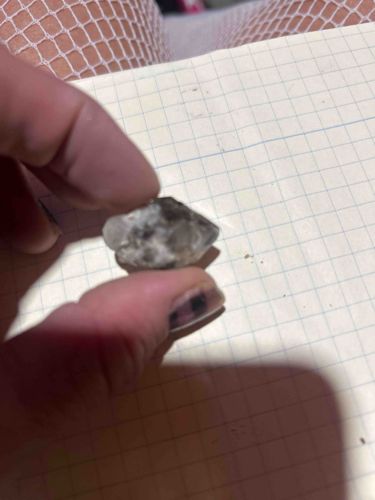
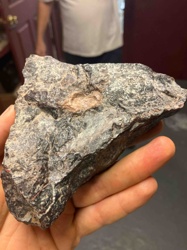
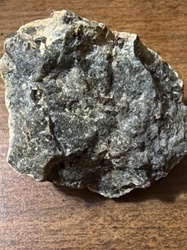
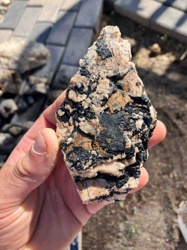
The item appears to be an irregularly shaped mineral specimen, likely a fragment or a small, naturally occurring crystal. Its primary coloration is a translucent to opaque milky white, intermingled with prominent veins and patches of dark grey or black material. The specimen exhibits a rough, unpolished surface with visible facets and cleavage planes indicative of a natural break or formation. It is held between two fingers, suggesting a small size, likely no more than 2-3 centimeters in its longest dimension. The overall shape is angular, without any discernible signs of carving, cutting, or human modification. There are no apparent maker's marks, signatures, or stamps. The material appears dense, typical of most common minerals. The condition shows no significant signs of wear beyond its natural, unrefined state; there are no obvious cracks, chips (beyond its natural form), or repairs. Based on its visual characteristics, it could potentially be a form of quartz with inclusions, or perhaps part of an igneous or metamorphic rock containing multiple mineral components. Without further testing like hardness, streak, or crystal structure analysis, a precise identification is not possible from the image alone. Its estimated age is geological, given its natural formation, and its style is raw and unadorned. The craftsmanship is entirely natural, showcasing the inherent beauty and structural integrity of the earth's geological processes.
AI Appraisal Report
I have carefully examined the provided image of the rock and mineral specimen. Visually, it presents as an irregularly shaped fragment, approximately 2-3 cm in its longest dimension, dominated by milky white translucent to opaque material interspersed with significant dark grey to black veins or inclusions. The surface is rough and unpolished, showing natural facets and cleavage planes consistent with a natural formation. Its condition appears excellent for a natural specimen, with no evidence of artificial damage, repairs, or modification. Authenticity as a natural geological specimen seems self-evident from its raw form; there are no indicators of it being man-made or a composite. The item appears to be an ordinary mineral or rock fragment, potentially a form of quartz with dark mineral inclusions, or a piece of common igneous or metamorphic rock. Without advanced testing like hardness, specific gravity, streak, or X-ray diffraction, precise mineral identification is impossible from imagery alone. This significantly impacts valuation. General market conditions for aesthetically pleasing, well-formed, or rare mineral specimens can be quite high. However, for unidentifiable, common-looking rock fragments, demand is extremely low, limited mainly to beginner collectors or educational purposes. Its rarity is currently indeterminate but appears to be a common type of rock. Therefore, lacking any exceptional crystallization, color, size, or confirmed rarity/identity, the intrinsic value is minimal. Should it be identified as a rare mineral or geological formation, its value could increase, but based on visual evidence, this is unlikely. For full authentication and accurate valuation, a physical examination, mineralogical testing, and potentially spectral analysis would be required to identify the specific mineral composition and rule out commonality. As it stands, it’s a geological curiosity rather than a valuable collectible.