AI estimate as of July 24, 2025 · verify with a professional before acting
AI-Generated · Verify before acting
Everything on this page is generated by AI for informational purposes only. AI can make mistakes — the AI may misidentify items or misattribute them (artist, maker, brand, designer, origin, era). This is not an official valuation and should not be used for insurance, sale, tax, estate, legal, or lending purposes — or any decision requiring a certified appraisal. It is not an authoritative claim about any person, brand, or rights holder — do not share or rely on it as a factual statement about a third party. Always consult qualified professionals before making financial decisions.
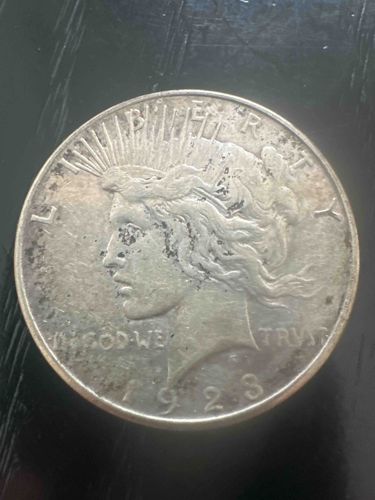
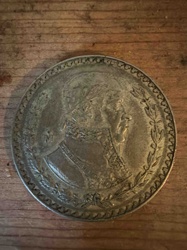
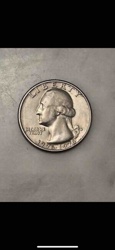
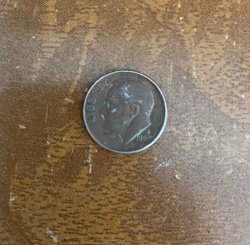
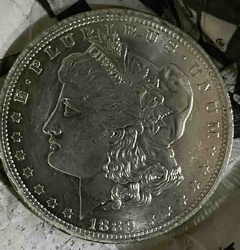
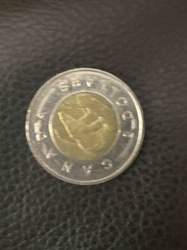
The item is a United States Peace Dollar, specifically an example minted in 1923. It is a circular metallic coin, likely composed of 90% silver and 10% copper, consistent with Peace Dollar specifications. The obverse depicts the profile of Lady Liberty, facing left, with rays emanating from behind her head, symbolizing the dawn of peace. Her hair is rendered with flowing locks, and a diadem or crown-like element rests upon her head. The word 'LIBERTY' is inscribed above her, following the curve of the coin's rim, though its legibility is somewhat compromised by wear and oxidation. Below her chin, the motto 'IN GOD WE' is partially visible, with 'TRUST' appearing to her right at a lower point. The minting year '1923' is clearly impressed at the bottom of the coin. The coin exhibits a significant degree of surface wear, particularly across Liberty's face and hair, where details appear softened and some original luster is lost. There are also noticeable dark encrustations or toning spots, especially on Liberty's face and neck, and scattered across the field. The rim shows some minor abrasions, and the overall patina suggests age and circulation. The craftsmanship is typical of early 20th-century U.S. coinage, with the design elements still discernible despite the evident wear and surface irregularities. This coin belongs to the Art Deco period, or immediately post-World War I era, reflecting the nation's optimism for peace.
AI Appraisal Report
I have thoroughly examined the provided image of this 1923 Peace Silver Dollar. Based on visual inspection, the coin's authenticity appears to be high. It exhibits characteristic design elements, relief, and overall appearance consistent with genuine Peace Dollars from that mintage year. The composition, as described, aligns with standard specifications for this series (90% silver, 10% copper).
Regarding condition, this coin shows significant signs of wear. Details on Lady Liberty's face and hair are softened, indicating circulation, and much of the original mint luster has been lost. The presence of dark encrustations or toning spots, particularly on Liberty's face and scattered throughout the field, suggests environmental exposure and age. These surface irregularities, along with minor rim abrasions, place this coin firmly in a lower circulated grade, likely Fine (F) to Very Fine (VF) range, rather than Uncirculated or AU. The Art Deco design and the historical context of post-WWI optimism remain discernible despite the wear.
In terms of market conditions, 1923 Peace Dollars are common in circulated grades. While popular with collectors, coins in this condition typically do not command premium prices unless they possess unique characteristics, such as exceptional toning (which this coin's toning is not) or a scarce error (none visible). Demand for circulated common-date Peace Dollars is steady but not intense enough to drive significant value increases. Comparables in similar condition often sell in the low-end collector market.
Several factors impact its value negatively: the significant surface wear, the presence of dark encrustations, and the lack of original luster. These aspects diminish its aesthetic appeal and numismatic grade. The primary factors for its value will be its silver content and its desirability as a collectible entry-level Peace Dollar.
It is crucial to note that while authenticity seems high from the image, definitive verification requires in-person examination. A direct inspection would allow for a more precise assessment of surface characteristics, weight, diameter, and edge details, which are critical for confirming authenticity and grading. Spectrographic analysis could confirm metal composition, and forensic examination of the surface could distinguish between genuine toning/patina and artificial discoloration or damage. Without physical inspection, I cannot rule out subtle alterations or hidden damage.