AI estimate as of August 5, 2025 · verify with a professional before acting
AI-Generated · Verify before acting
Everything on this page is generated by AI for informational purposes only. AI can make mistakes — the AI may misidentify items or misattribute them (artist, maker, brand, designer, origin, era). This is not an official valuation and should not be used for insurance, sale, tax, estate, legal, or lending purposes — or any decision requiring a certified appraisal. It is not an authoritative claim about any person, brand, or rights holder — do not share or rely on it as a factual statement about a third party. Always consult qualified professionals before making financial decisions.
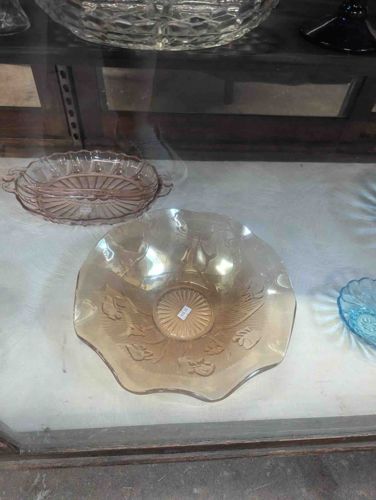
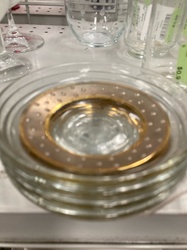
The item is a vintage serving bowl, likely made of pressed glass, exhibiting a distinctive marigold luster, characteristic of Carnival Glass. The bowl has a multi-lobed or ruffled rim, giving it an organic, wavy appearance rather than a perfectly circular shape. In terms of physical characteristics, it appears to be of a medium size, suitable for serving salads, fruits, or a decorative centerpiece. The material is translucent glass, with color variations ranging from amber to a richer, iridescent golden-brown depending on the light, which is typical of iridescent finishes.
Observable features include a central medallion design on the interior base, which appears to be a sunburst or starburst pattern, adding a focal point to the bowl's design. Extending from this central motif are molded floral or foliage patterns, possibly grapevines, leaves, or stylized scrollwork, that radiate outwards towards the rim. These raised designs contribute to the tactile and visual texture of the piece. There is a small white sticker, possibly a price tag, visible on the central medallion.
Regarding condition, the glass appears to be in relatively good shape with no immediately obvious cracks or chips visible from this angle. There might be minor surface wear, scuffs, or slight loss of iridescence consistent with age and typical use, though this cannot be definitively assessed without closer inspection. The overall craftsmanship suggests mass production typical of the early to mid-20th century. Based on the style and iridescence, it is highly probable that this item dates from the Carnival Glass era, spanning from approximately 1907 to the 1930s, or possibly later reproductions of the style. The quality seems good for its type, reflecting durable machine-pressed glass.
AI Appraisal Report
I have carefully examined the provided image of this Carnival Glass serving bowl. Based on its distinctive marigold luster, multi-lobed ruffled rim, and molded sunburst and floral/foliage patterns, it is consistent with pieces produced during the Carnival Glass era, primarily between 1907 and the 1930s. The translucent glass with varying iridescent golden-brown hues is characteristic of this type of pressed glass.
From the image, the condition appears to be relatively good. I observe no immediate cracks or large chips, which are significant detractors of value. Minor surface wear or slight loss of iridescence is to be expected with age and typical use, though this cannot be fully assessed without a direct, tactile inspection. The small white sticker on the central medallion is a minor issue and can likely be carefully removed.
In terms of market conditions, Carnival Glass, while popular among collectors, generally does not command extremely high prices unless it's a rare pattern, a particularly vibrant color, or an unusual form. Common patterns, like the one seen here (possibly a variation of a 'Grape' or 'Leaf' pattern), are readily available. The demand is steady but not surging. This piece's 'good' condition and attractive iridescence make it marketable.
Factors impacting value include pattern rarity, color saturation, and the absence of damage (chips, cracks, significant iridescence loss). This piece appears to be a common pattern in a common color (marigold), which limits its top-tier value.
Limitations in authenticity verification from images alone are significant. While the style strongly suggests genuine Carnival Glass, without physical inspection, I cannot entirely rule out a modern reproduction or confirm the exact pattern name. An in-person examination would allow for tactile assessment of the glass quality, detection of minor flaws not visible in the image, and a more precise evaluation of iridescence quality. Provenance documentation (e.g., original sales receipts, family history) would also strengthen authenticity. Scientific testing, such as elemental analysis, is typically not warranted for common Carnival Glass unless a serious authenticity dispute arises for a high-value piece.