AI estimate as of November 5, 2025 · verify with a professional before acting
AI-Generated · Verify before acting
Everything on this page is generated by AI for informational purposes only. AI can make mistakes — the AI may misidentify items or misattribute them (artist, maker, brand, designer, origin, era). This is not an official valuation and should not be used for insurance, sale, tax, estate, legal, or lending purposes — or any decision requiring a certified appraisal. It is not an authoritative claim about any person, brand, or rights holder — do not share or rely on it as a factual statement about a third party. Always consult qualified professionals before making financial decisions.
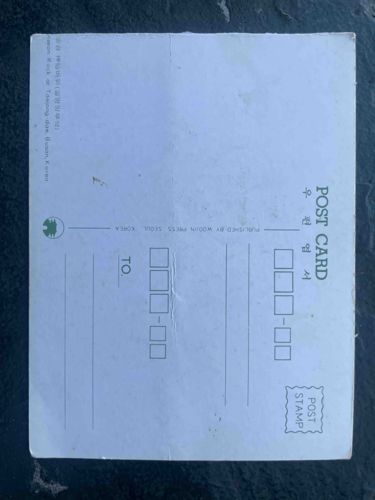
This item is the reverse side of a postcard, primarily featuring a light blue/grey hue, suggesting it is made from standard postcard-grade cardstock. The surface has a matte finish with some subtle variations in color, possibly due to minor staining or aging. The overall construction appears to be a typical rectangular postcard format, consistent with standard postal requirements. Notable features include printed text and ruled lines designed for mailing. In the upper right corner, "POST CARD" is printed vertically, accompanied by Korean characters "우편엽서" (upeon-yeopseo), which also translate to postcard. Below this, there is a designated area marked for a 'POST STAMP' within a decorative, wavy-edged box. The postcard is divided into two main sections by a vertical line, common for address and message. On the left side, horizontally oriented, is the text "PUBLISHED BY WOOLIN PRESS SEOUL KOREA," indicating the manufacturer and origin. Further to the left, there is a small, stylized tree or plant motif logo, often associated with a publishing house or environmental theme. Below 'PUBLISHED BY' text, aligned vertically, is the word "TO." with several empty square boxes, presumably for the recipient's address and postal code. The condition of the postcard shows some signs of age and handling, including a slight discoloration, particularly visible along the edges and corners, and a few faint scuff marks on the surface. There are no obvious tears or significant creases, but the paper exhibits a slight overall wear consistent with an item that has been stored for some time. The print quality is clear and legible, indicating good manufacturing standards for its time. Based on the publisher 'WOOLIN PRESS SEOUL KOREA', it likely dates from the mid-to-late 20th century. The design is functional and typical of a standard international postcard.
AI Appraisal Report
Upon my virtual examination of this Korean postcard's reverse side, I observe a standard-issue item with typical mailing divisions and text. The 'POST CARD' and '우편엽서' designations, along with the 'POST STAMP' area, are consistent with authentic postal stationery. The publisher information, 'PUBLISHED BY WOOLIN PRESS SEOUL KOREA,' places its origin firmly in mid-to-late 20th century South Korea. The subtle discoloration and scuff marks are indicative of age and typical handling, yet there are no significant tears or creases, suggesting reasonable preservation for its age. The print quality remains clear and legible.
From a market perspective, common postcards from the mid-to-late 20th century, particularly those without significant historical events depicted or famous senders, generally command modest prices. Such items are frequently found in ephemera collections and often sold in lots. The "WOOLIN PRESS" publisher, while identifiable, doesn't appear to represent a particularly rare or sought-after imprint among postcard collectors unless associated with unique or limited-run artistic designs (which is not visible on this reverse side). Demand for generic, unused postcards of this era is relatively low, typically driven by country-specific collectors or those building general ephemera archives.
Factors impacting its value include its common design and lack of specific historical significance or unique imagery (as far as the reverse indicates). Its unused state preserves its collectible condition, but it doesn't elevate it to a high-value item.
My assessment is based solely on the provided image. For full authentication and a more precise valuation, an in-person examination would be crucial to verify paper quality, ink type, and detect any physical alterations or signs of reproduction not visible in the image. Provenance documentation, such as details of its acquisition or any known history of use, would provide further context. Without seeing the front or any other contextual information, its value remains within a general hobbyist collecting range.