AI estimate as of October 30, 2025 · verify with a professional before acting
AI-Generated · Verify before acting
Everything on this page is generated by AI for informational purposes only. AI can make mistakes — the AI may misidentify items or misattribute them (artist, maker, brand, designer, origin, era). This is not an official valuation and should not be used for insurance, sale, tax, estate, legal, or lending purposes — or any decision requiring a certified appraisal. It is not an authoritative claim about any person, brand, or rights holder — do not share or rely on it as a factual statement about a third party. Always consult qualified professionals before making financial decisions.
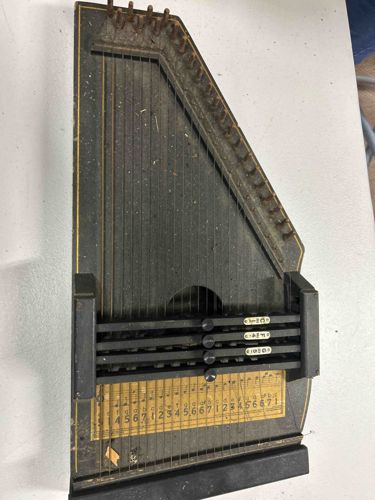
This is a vintage autoharp, a type of chorded zither, characterized by its approximately rectangular body with one corner angled. The instrument features a dark, likely black-painted, wooden frame that is visibly worn with scuffs, scratches, and a layer of dust and grime accumulated over time, suggesting significant age and prolonged storage. The strings, of which there are numerous running lengthwise across the soundboard, appear to be a mix of plain and wound varieties, showing signs of oxidation and some discoloration. Many strings are present, but their tension and integrity are not fully ascertainable from the image, though some appear slack or broken.
A key feature is the chord bar mechanism located on the right side of the soundboard. It consists of three horizontal bars, each with white-labeled 'mutes' or 'dampers' indicating chords such as 'C major' (although partially obscured, clearly starts with 'C M', likely C major), 'G7' (partially obscured, but 'G7' is discernible), and another, heavily worn and illegible. These bars are operated by circular, likely black plastic or wooden, buttons. Below the chord bars, a printed or stenciled paper or thin wood strip with musical notation, numbers (1-7), and letters (a-g) is present, acting as a guide for playing. This strip is discolored, faded, and shows signs of wear, particularly at the bottom left where a small piece appears torn or detached. The tuning pins, visible along the top angled edge, are rusty, indicating the instrument has been exposed to moisture or humidity. The overall condition suggests that this autoharp is in unrestored, 'as found' condition, likely from the mid-20th century or earlier, requiring significant cleaning, restringing, and potential repair to be playable. The craftsmanship, though showing age, points to a period of mass production for home musical entertainment.
AI Appraisal Report
Upon examining this vintage autoharp, it's clear it is in 'as found' unrestored condition. The dark-painted wooden frame exhibits significant wear, with scuffs, scratches, and a heavy accumulation of dust and grime, consistent with prolonged storage and age. The strings show considerable oxidation, discoloration, and some appear slack or broken, indicating a need for full restringing. The tuning pins are rusty, suggesting exposure to moisture. The chord bar mechanism, while present, shows heavy wear on the labels and the guide strip below is discolored, faded, and partially torn. Authenticity as a period piece, likely mid-20th century, is well supported by its visible construction and the signs of age.
Market conditions for unrestored vintage autoharps are generally modest. While some early or rare models can command higher prices, this example appears to be a mass-produced model, typically found in 'good' playable condition for $150-$300. In its current 'poor' condition, requiring extensive restoration (cleaning, restringing, potential repair of action/dampers, and fret/guide strip replacement), its value is significantly reduced. Comparables in similar condition often sell in the parts-or-project range. Demand for such items is niche, primarily among hobbyists or those seeking restoration projects rather than immediate playable instruments. Rarity is not a significant factor here; these instruments were common. The major impact on value is its extensive need for professional restoration, which would likely exceed the instrument's fully restored market value.
Limitations in authenticity verification from images alone include the inability to fully assess internal structural integrity, soundboard condition (e.g., cracks or warping), and the precise functionality of the chord bar mechanism. An in-person examination would allow for a hands-on assessment of string tension, damper functionality, and a more accurate estimate of restoration costs. Provenance documentation could help establish a more precise manufacturing date or previous ownership, though it's unlikely to significantly impact value for a common model in this condition. Scientific testing is not typically applied to instruments of this type and value level.