AI estimate as of August 6, 2025 · verify with a professional before acting
AI-Generated · Verify before acting
Everything on this page is generated by AI for informational purposes only. AI can make mistakes — the AI may misidentify items or misattribute them (artist, maker, brand, designer, origin, era). This is not an official valuation and should not be used for insurance, sale, tax, estate, legal, or lending purposes — or any decision requiring a certified appraisal. It is not an authoritative claim about any person, brand, or rights holder — do not share or rely on it as a factual statement about a third party. Always consult qualified professionals before making financial decisions.
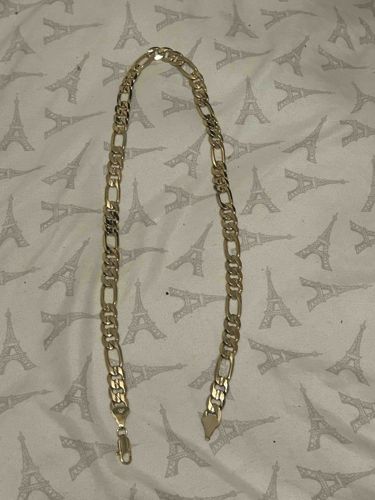
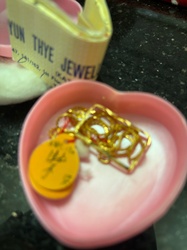
The item is a gold-toned Figaro chain, likely intended to be worn as a bracelet or a shorter necklace, given its length. It features the characteristic Figaro link pattern, which consists of three smaller, rounder links alternating with one elongated oval link. The chain appears to be constructed from metal, specifically exhibiting a bright yellow gold color, suggesting it could be solid gold, gold-filled, or gold-plated. The links are uniform in size and shape throughout the visible length, indicating machine manufacturing. The surface of the links shows a polished finish, which reflects light, contributing to its lustrous appearance.
Upon closer inspection, the chain appears to have a spring-ring clasp on one end, which is a common and secure type of fastening mechanism for jewelry. The other end terminates in a pointed, solid link, presumably designed to attach to the clasp, though the connection point is not fully visible. There are no obvious signs of significant wear such as heavy scratches, dents, or tarnishing visible in the provided image. The overall condition appears to be good, with no visible breaks or major damage to the links themselves. There are no discernible maker's marks or stamps in the visible areas, which would typically be found on the clasp or a nearby jump ring if present. The style is classic and timeless, popular across various eras, making it hard to pinpoint an exact age without more information, but similar designs have been prevalent from the late 20th century to the present day. The quality of craftsmanship seems to be standard for mass-produced jewelry of this type, with well-formed and interconnected links.
AI Appraisal Report
Upon visual examination of the provided image, I assess this gold-toned Figaro chain to be in good overall condition. The links exhibit a uniform size and shape, indicating machine manufacturing, and the polished finish reflects light well, contributing to its lustrous appearance. There are no obvious signs of significant wear such as heavy scratches, dents, or tarnishing. The presence of a spring-ring clasp suggests a common and secure fastening mechanism.
However, limitations in authenticity verification from images alone are significant. While the bright yellow gold color is appealing, it's impossible to definitively determine from a photograph whether the chain is solid gold, gold-filled, or merely gold-plated. The lack of visible maker's marks or stamps adds to this uncertainty, as these are critical for assessing origin and material purity.
Market conditions for Figaro chains are generally stable, as they are a classic and perpetually popular style. Demand is consistent for both genuine gold and costume jewelry versions. However, rarity is not a factor here; this is a mass-produced design. The primary factor impacting value is the actual metal composition. If this were authenticated as 14K or 18K solid gold, its value would be significantly higher, based on the current gold market price by weight. If it’s gold-filled, the value would be moderate, and if merely plated, it would hold minimal intrinsic value.
For full authentication, an in-person examination would be crucial. This would allow for tactile inspection, precise measurement of length and weight, and, most importantly, the ability to locate and scrutinize any hidden hallmarks or stamps. Scientific testing, such as X-ray fluorescence (XRF) analysis, would be necessary to definitively determine the metal composition (solid gold, gold-filled, or plated) and karatage, which is paramount for an accurate appraisal.