AI estimate as of September 9, 2025 · verify with a professional before acting
AI-Generated · Verify before acting
Everything on this page is generated by AI for informational purposes only. AI can make mistakes — the AI may misidentify items or misattribute them (artist, maker, brand, designer, origin, era). This is not an official valuation and should not be used for insurance, sale, tax, estate, legal, or lending purposes — or any decision requiring a certified appraisal. It is not an authoritative claim about any person, brand, or rights holder — do not share or rely on it as a factual statement about a third party. Always consult qualified professionals before making financial decisions.
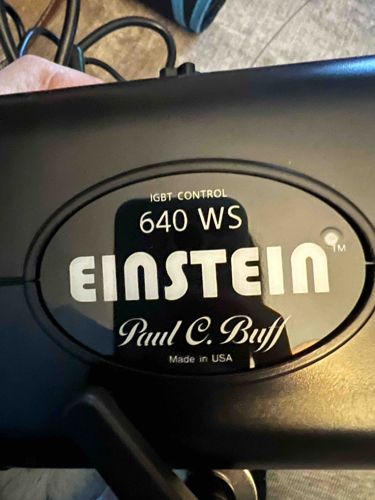
The item is a professional studio strobe or monolight, identified by the prominent 'EINSTEIN' branding and the '640 WS' (Watt Seconds) power rating, indicating its light output capability. Below the main brand, the name 'Paul C. Buff' is clearly legible, signifying the specific manufacturer. The label also states 'IGBT CONTROL', which refers to Insulated Gate Bipolar Transistor control, an advanced technology used in modern power electronics for efficient and precise flash duration and power output control, often associated with high-speed sync and freeze capabilities. The 'Made in USA' designation further specifies its origin. The unit appears to be housed in a durable, matte black casing, likely made of metal or robust plastic, typical for professional photographic equipment designed for studio use. Only a small section of the overall unit is visible, primarily focusing on the labeling, but the sleek design suggests a contemporary aesthetic. While the full physical characteristics (dimensions, weight, heat sinks, port configurations) cannot be determined from this single image, the visible portion shows a clean, well-maintained surface with no apparent scuffs, scratches, or significant wear. The lettering on the label is crisp and white against a black oval background, contrasting effectively with the black body of the unit. The overall impression is one of a high-quality, professional-grade piece of equipment, likely from the 21st century given the 'IGBT CONTROL' technology.
AI Appraisal Report
Based on my visual examination of the provided image, I can confirm this is a Paul C. Buff Einstein 640 WS Studio Strobe/Monolight. The prominent 'EINSTEIN 640 WS' and 'Paul C. Buff' branding, along with 'IGBT CONTROL' and 'Made in USA', are clearly legible and consistent with authentic units from this manufacturer. The visible portion of the unit appears to be in excellent aesthetic condition; the matte black casing shows no visible scuffs, scratches, or wear, and the white lettering against the black oval is crisp. This superficial assessment suggests a well-maintained piece of equipment.
From a market perspective, the Paul C. Buff Einstein 640 WS is a highly regarded professional studio strobe known for its advanced IGBT technology, offering precise power control and fast flash durations. While these units are no longer produced new, there is a consistent demand for them on the used market due to their durability, performance, and the established ecosystem of Paul C. Buff modifiers. Comparables typically sell for between $400-$600, depending heavily on the complete functional condition and included accessories. Factors impacting value include the total number of flashes, battery health (if applicable, though this is a studio unit), and the presence of any internal issues not visible externally. The model is not particularly rare, but the sustained demand keeps its value relatively stable.
It is crucial to note the limitations of authenticating and valuing solely from an image. While the visual details align with an authentic unit, I cannot definitively verify its operational functionality, internal condition, or total flash count. A full authentication and precise appraisal would necessitate an in-person physical examination to test all functions (flash output, recycle times, modeling lamp, port integrity), connect it to a power source, and ideally review any provenance documentation, such as original purchase receipts or service records. Without these, the appraisal value is based purely on the excellent apparent cosmetic state and general market trends for functional units.