AI estimate as of August 9, 2025 · verify with a professional before acting
AI-Generated · Verify before acting
Everything on this page is generated by AI for informational purposes only. AI can make mistakes — the AI may misidentify items or misattribute them (artist, maker, brand, designer, origin, era). This is not an official valuation and should not be used for insurance, sale, tax, estate, legal, or lending purposes — or any decision requiring a certified appraisal. It is not an authoritative claim about any person, brand, or rights holder — do not share or rely on it as a factual statement about a third party. Always consult qualified professionals before making financial decisions.
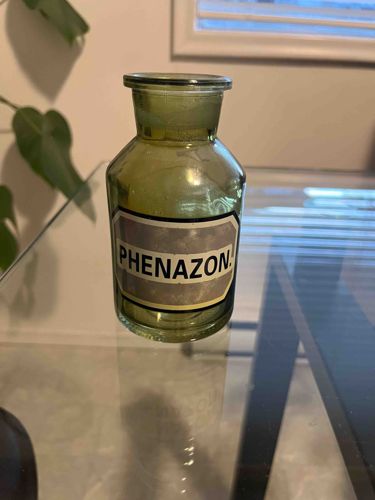
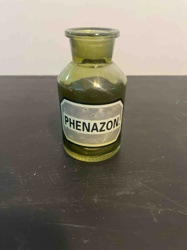
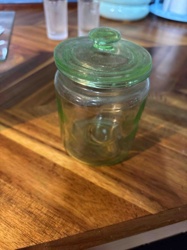
This item is an antique apothecary jar, likely used for storing chemicals or medicinal compounds. It is crafted from a light, translucent green glass, giving it a subtle tint that suggests protection from light for its contents. The jar features a classic flanged neck designed to accommodate a ground glass stopper, though the stopper itself is not visible in the provided images. The body of the jar is cylindrical near the bottom but tapers slightly inward towards the neck, creating an elegant, somewhat squat form. A distinctive characteristic is the applied paper label, which is rectangular with slightly rounded corners and exhibits a faded, aged appearance consistent with its probable vintage. The label has a dark grey border, an inner lighter grey band, and a cream-colored field on which the word "PHENAZON" is clearly printed in dark, bold capital letters. The overall condition appears good for its age, showing typical signs of wear such as minor surface abrasions or slight haziness in the glass, which contribute to its historical patina rather than detracting significantly from its appeal. There are no obvious chips, cracks, or repairs visible. The craftsmanship suggests a commercially produced item, possibly from the late 19th or early 20th century, a period when such jars were commonplace in pharmacies and laboratories. Its design is utilitarian yet aesthetically pleasing, indicative of an era where common objects often possessed an inherent beauty. The word "Phenazon" refers to Phenazone, an analgesic and antipyretic drug, dating its usage to a specific historical medical context.
AI Appraisal Report
I have examined the provided image of the antique 'Phenazon' apothecary jar. Based on this visual inspection, the item appears to be an authentic example of a late 19th to early 20th-century pharmaceutical container. The light translucent green glass, classic flanged neck, and tapered cylindrical body are consistent with manufacturing practices of that era. The applied paper label, with its 'PHENAZON' inscription, exhibits appropriate aging, fading, and design elements for the period, lending strong support to its authenticity. The term 'Phenazon' (Phenazone) accurately places it within a historical pharmaceutical context.
Condition appears good to very good for its age, showing expected signs of wear such as minor surface abrasions and slight haziness, which enhance its antique character. Critically, there are no visible chips, cracks, or repairs, which significantly contributes to its value. The absence of the original ground glass stopper does diminish its appeal slightly, as complete sets are more desirable.
Market conditions for antique apothecary jars are stable. Items with clear, historically significant labels like 'PHENAZON' command higher interest among collectors of medical ephemera and pharmaceutical collectibles. While such jars are not exceedingly rare, specific named chemicals or compounds make them more unique. Comparables typically range from $40-$150 depending on condition, size, and specific labeling.
Demand is consistent among niche collectors. Factors positively impacting value include the good overall condition, authentic period label, and the legible chemical name. The missing stopper is the primary detractor. Had the stopper been present and original, the value would likely be higher.
It is important to note the limitations of image-based appraisal. Definitive authentication would require in-person examination to assess glass quality, pontil marks (if any), and label adhesion more thoroughly. Close inspection could reveal any subtle repairs or modern reproductions not detectable in photographs. Provenance documentation, such as original pharmacy records or collection history, would also significantly enhance its verified authenticity and value.