AI estimate as of September 25, 2025 · verify with a professional before acting
AI-Generated · Verify before acting
Everything on this page is generated by AI for informational purposes only. AI can make mistakes — the AI may misidentify items or misattribute them (artist, maker, brand, designer, origin, era). This is not an official valuation and should not be used for insurance, sale, tax, estate, legal, or lending purposes — or any decision requiring a certified appraisal. It is not an authoritative claim about any person, brand, or rights holder — do not share or rely on it as a factual statement about a third party. Always consult qualified professionals before making financial decisions.
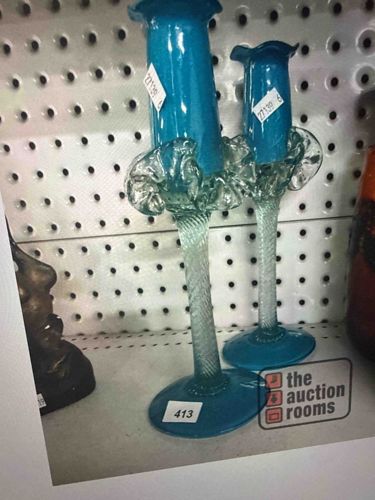
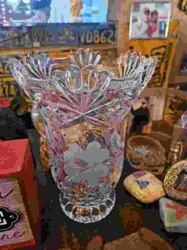
This is a pair of decorative candlesticks, likely crafted from art glass, featuring a distinctive two-part construction. Each candlestick comprises a teal-blue base and upper candle holder, connected by a clear, textured, twisted stem. The base is flat and circular, providing stability for the slender stem. The stem itself is a prominent feature, exhibiting a twisted or fluted design that adds visual interest and suggests a hand-blown or artisan manufacturing process. Above the stem, a clear glass ruffle or flounce encircles the lower part of the candle cup, exhibiting organic, wavy edges that appear intentionally irregular, contributing to an artistic or whimsical aesthetic. The candle cup itself is a solid teal-blue, mirroring the color of the base, and features a gently ruffled rim, echoing the clear glass ruffle below. The height of the candlesticks is noticeably different, with one being taller than the other, suggesting they might be designed as a graduated set. Visible condition includes some surface dust or slight smudges, but no obvious chips, cracks, or significant damage are apparent from the image. The glass has a glossy finish. There are price or identification stickers on both the bases and the upper teal sections, indicating they are prepared for sale, possibly at an auction or retail setting. The overall style suggests a mid-20th century to contemporary decorative arts piece, prioritizing aesthetic appeal over utilitarian formality. The craftsmanship, particularly the twisted stem and ruffled elements, indicates a degree of skill in glassblowing.
AI Appraisal Report
This pair of teal and clear glass candlesticks presents as a charming example of decorative art glass, likely dating from the mid-20th century to contemporary production. Visually, the items appear to be in good condition; I observe no obvious chips, cracks, or significant damage, only some surface dust, as if they've been recently handled for display or sale. The glossy finish is intact across both pieces. The two-part construction, featuring a clear, twisted stem separating the colored base and upper candle holder, is a distinctive design element. The ruffled edges on both the clear glass element and the teal candle cup add an artisanal touch.
Market-wise, these pieces fall into the general decorative glassware category. Similar art glass candlesticks, particularly those with a two-tone or sculptural design, tend to achieve modest prices at auction and in retail, especially from less renowned makers. Demand for such items is generally steady, driven by interior decorators and collectors seeking accent pieces. The varying heights, while adding visual interest, do not significantly alter the market value compared to a uniform pair, though they suggest a deliberate artistic choice. Rarity is not a major factor here, as many glass studios produced similar items during the period. The presence of stickers suggests they may be from a larger production run rather than unique studio pieces.
Crucially, my assessment is based solely on a visual examination of the provided image. While the condition appears good, a hands-on inspection would be essential to confirm the absence of hairline cracks, fleabites, or internal flaws that are not visible. Authentication of the maker or precise dating would require examining any etched signatures, pontil marks, or production marks not visible in the image, or reviewing provenance documentation, such as original purchase receipts or maker certificates. Without these, attributing them to a specific studio or designer is impossible, which limits their top-tier market value. The current valuation reflects their aesthetic appeal and apparent good condition as attractive decorative objects.