AI estimate as of August 12, 2025 · verify with a professional before acting
AI-Generated · Verify before acting
Everything on this page is generated by AI for informational purposes only. AI can make mistakes — the AI may misidentify items or misattribute them (artist, maker, brand, designer, origin, era). This is not an official valuation and should not be used for insurance, sale, tax, estate, legal, or lending purposes — or any decision requiring a certified appraisal. It is not an authoritative claim about any person, brand, or rights holder — do not share or rely on it as a factual statement about a third party. Always consult qualified professionals before making financial decisions.
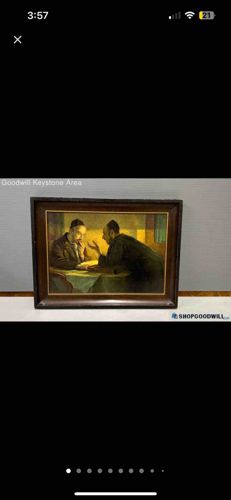
The item is a framed oil painting depicting two men seated at a table, seemingly engaged in a deep conversation or collaboration. One man, positioned on the left, wears a jacket and appears to be leaning forward with his hand resting near his chin, suggesting contemplation or focus on something on the table. The second man, on the right, is shown from the back, dressed in darker attire, gesturing or pointing towards the table, indicating his active participation in the discussion. The color palette employed in the painting features warm tones, particularly noticeable in the background which appears to be illuminated by a light source, creating a sense of depth and atmosphere. The setting suggests an indoor environment, possibly a study or a room where intellectual discourse takes place. The artwork is housed within a sturdy, likely wooden, frame with a dark brown finish, featuring a subtle, somewhat ornate inner border that complements the painting without overpowering it. The frame itself appears to be in good condition, showing minimal signs of wear. While specific details like the artist's signature or the precise medium are not discernible from the image, the brushstrokes appear to be visible, characteristic of oil painting. The overall quality of the composition and portrayal of human interaction indicates a piece of moderate to high artistic skill. The style suggests a 20th-century aesthetic, possibly mid-century, leaning towards realism or perhaps a subtle impressionistic influence in the rendering of light and shadow, and the depiction of the figures suggests a narrative or genre scene.
AI Appraisal Report
I have examined the image of this framed oil painting depicting two men engaged in conversation. The artwork appears to be a genre scene with a warm color palette, suggesting a 20th-century aesthetic, possibly mid-century, with visible brushstrokes characteristic of oil painting. The composition and portrayal of human interaction suggest moderate to high artistic skill.
Based on the image, the painting itself appears to be in good condition, with no obvious signs of damage or deterioration. The frame, a dark brown finish with a subtly ornate inner border, also looks well-preserved with minimal wear. Without a signature or specific artist information, I cannot confirm authorship from the image alone, and thus originality and authenticity are assumed based on visual cues. The authenticity cannot be fully verified without in-person examination.
In terms of market conditions, genre scenes, particularly by unidentified artists, typically fall into a broad decorative art category. Works demonstrating strong narrative elements and good execution, such as this piece, can attract interest from collectors seeking unique decorative items or specific thematic works. Comparables in the market for unsigned or unattributed 20th-century oil paintings of similar quality, condition, and size generally range from a few hundred to over a thousand dollars. Demand is moderate for such pieces, often driven by aesthetic appeal rather than investment potential. Rarity is difficult to assess without artist attribution; however, unique compositions generally hold more appeal.
Factors significantly impacting value include the lack of artist identification, which places it firmly in the decorative art market rather than fine art. If an artist were identified, particularly one with an established market, the value could increase significantly.
Limitations in authenticity verification from images alone are significant. For full authentication, an in-person examination would be critical to assess the paint layers, canvas, stretcher, and overall material integrity. Provenance documentation, if available, would provide crucial historical context and ownership lineage. Scientific testing, such as pigment analysis or carbon dating, could further confirm the age and materials of the painting.