AI estimate as of September 4, 2025 · verify with a professional before acting
AI-Generated · Verify before acting
Everything on this page is generated by AI for informational purposes only. AI can make mistakes — the AI may misidentify items or misattribute them (artist, maker, brand, designer, origin, era). This is not an official valuation and should not be used for insurance, sale, tax, estate, legal, or lending purposes — or any decision requiring a certified appraisal. It is not an authoritative claim about any person, brand, or rights holder — do not share or rely on it as a factual statement about a third party. Always consult qualified professionals before making financial decisions.
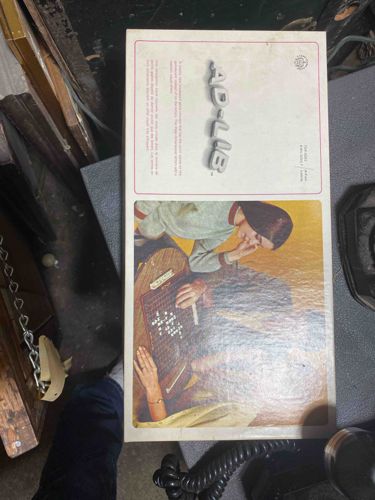
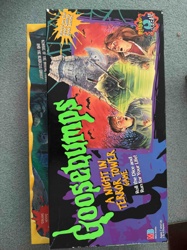
The item is identified as a vintage 'Ad-Lib' word game, presented in its original cardboard box packaging. The box appears to be rectangular in shape, designed to contain the game components. The top portion of the box lid is predominantly white or off-white, featuring the game title 'AD-LIB' in a stylized, three-dimensional silver or gray font, casting a subtle shadow, suggesting a raised effect or an intentional design element. To the left of the title, there is a block of text, likely game instructions or a brief description, printed in red or a reddish-brown ink. In the upper right corner of this white section, there is a small, circular emblem or logo. Below this white section, the majority of the box lid features a colorful illustration depicting two individuals, likely players, engrossed in the game. One individual, possibly a male, is shown from the chest up, seemingly concentrating. The other individual's hands are visible, placed over a game board with visible word tiles or pieces arranged on it. The illustration suggests an indoor setting, possibly at a wooden table. The overall color palette of the illustration includes warm tones such as yellows, browns, and possibly greens. The box shows visible signs of age and wear, including discoloration, scuffs, and possible minor tears or indentations, consistent with an older cardboard item that has been stored for some time. There are no clear manufacturer's marks or specific dates discernible in the image, but the graphic style and typography suggest a mid-20th century origin, possibly from the 1950s to 1970s. The quality of the printing for the illustration appears to be a standard for game boxes of that era. The craftsmanship relates to the box's structural integrity, which appears largely intact despite the surface wear.
AI Appraisal Report
Upon visual examination of the 'Ad-Lib' word game in its original cardboard box, I assess its condition as fair to good. The box exhibits clear signs of age and handling, including discoloration, scuffs, and potential minor tears or indentations, consistent with an older cardboard item. Authenticity, based solely on the graphic style and typography, appears to be a genuine mid-20th century artifact, likely 1950s-1970s. However, without physical inspection, I cannot confirm the integrity of all internal components or rule out potential restorations to the box.
Market conditions for vintage board games like 'Ad-Lib' are generally stable but not robust unless the game is exceptionally rare or historically significant. Comparables for similar vintage word games in complete, used condition typically range from $15-$50. Demand for 'Ad-Lib' is moderate, primarily among collectors of vintage board games or those seeking nostalgic items from their youth. It's not considered a rare item. Factors significantly impacting value include the visible wear on the box, which detracts slightly. The lack of specific manufacturer's marks or dates on the box is a minor detraction but typical for this era. The game's condition (whether all components are present and functional) is the most critical factor that cannot be fully determined from images alone.
For full authentication and a more precise valuation, an in-person examination would be crucial to assess the completeness and condition of all game components. Provenance documentation (e.g., original sales receipts or family history) would add to its verifiable authenticity. Scientific testing, such as material dating of the cardboard, would generally not be cost-effective or necessary for an item of this value range.