AI estimate as of October 22, 2025 · verify with a professional before acting
AI-Generated · Verify before acting
Everything on this page is generated by AI for informational purposes only. AI can make mistakes — the AI may misidentify items or misattribute them (artist, maker, brand, designer, origin, era). This is not an official valuation and should not be used for insurance, sale, tax, estate, legal, or lending purposes — or any decision requiring a certified appraisal. It is not an authoritative claim about any person, brand, or rights holder — do not share or rely on it as a factual statement about a third party. Always consult qualified professionals before making financial decisions.
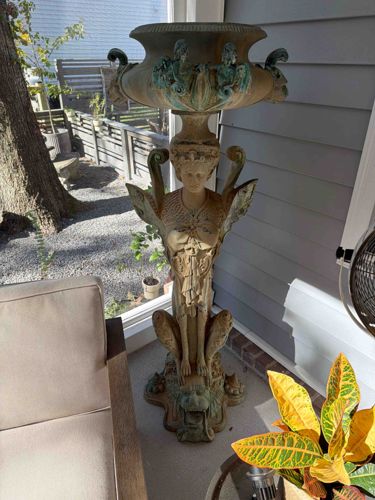
This item is a large, ornate garden urn supported by an integrated pedestal featuring a caryatid figure. The overall height appears to be substantial, likely between 4 and 6 feet, given its scale relative to the surrounding furniture and house siding. The material is a cast composition, likely concrete, cast stone, or a similar heavy material, designed to mimic aged bronze or stone. It exhibits a distinct patinated finish, predominantly a weathered greenish-brown with areas of more vibrant verdigris green, especially within the recesses of the decorative elements, suggesting exposure to the elements and natural aging.
The urn itself is wide and shallow, with a fluted rim and highly decorative handles that appear to be cast in the form of stylized griffins or grotesque figures. The body of the urn is adorned with intricate relief sculptures, including what appear to be human-like heads or masks amidst flowing foliage and perhaps shell motifs, all contributing to a classical or neoclassical aesthetic. Below the urn, a short, fluted column connects it to the pedestal base.
The pedestal is the most distinctive feature, sculpted in the form of a caryatid, a draped female figure. She wears an elaborate headdress, possibly a crown or adorned hair, and what looks like scale armor or patterned adornment across her chest. Her arms appear to be integrated into or flank the structure supporting the urn. Beneath the caryatid, the pedestal transitions into a base featuring more mythical creatures, possibly winged beasts or gargoyles, with substantial clawed feet. The very bottom of the base is an octagonal or multi-sided plinth, further embellished with a prominent lion-like mask at the front, from which water might traditionally flow if this were a fountain element, though it appears to solely be an ornamental planter here.
The condition shows significant weathering, consistent with an outdoor garden ornament, including areas of moss or algae growth, surface erosion, and color variation due to natural aging. There are no obvious signs of recent repairs or severe damage visible in the image, but the aged patina is a key characteristic. The craftsmanship is highly detailed, suggesting a piece designed to evoke classical grandeur, likely dating from the late 19th to mid-20th century, or a more contemporary reproduction in a historical style. The 'green' patination on certain raised features of the urn and base adds depth and highlights the sculptural details.
AI Appraisal Report
I have examined the provided image of this Neoclassical Style Patinated Garden Urn and Pedestal with Caryatid. The item presents as a substantial and highly ornate garden ornament, estimated between 4 and 6 feet tall, constructed from a cast composition material (likely concrete or cast stone) with an excellent aged patina suggestive of bronze or weathered stone. The intricate details, including fluting, relief sculptures, classical motifs, and especially the caryatid figure and mythical beast embellishments, indicate a high level of craftsmanship. The condition, while showing significant weathering, moss, and surface erosion consistent with an outdoor piece, contributes positively to its aesthetic appeal and apparent age; no severe damage or recent repairs are visible.
Market conditions for large, well-detailed garden statuary in the Neoclassical style are generally strong, with a consistent demand for pieces that evoke historical grandeur. Comparables for similar-sized and elaborately decorated cast stone or concrete urns and pedestals, especially those featuring caryatids or significant figural work, often sell in the $2,500 to $6,000 range, depending on precise age, origin, and detail. The 'green' patination is particularly desirable, adding depth and highlighting sculptural elements. While rarity is moderate for such pieces, an exceptionally well-preserved and detailed example like this commands a premium. The architectural scale and aesthetic quality significantly impact its value.
My assessment of authenticity is based solely on visual cues from the image. The style and weathering are consistent with pieces from the late 19th to mid-20th century, or a very high-quality contemporary reproduction in style. Without an in-person examination, I cannot definitively confirm its exact age or material composition. A physical inspection would allow for tactile assessment of material, examination for maker’s marks, and a closer look at construction techniques. Provenance documentation or scientific material testing (e.g., core samples) would be required for full authentication of age and origin.