AI estimate as of July 5, 2025 · verify with a professional before acting
AI-Generated · Verify before acting
Everything on this page is generated by AI for informational purposes only. AI can make mistakes — the AI may misidentify items or misattribute them (artist, maker, brand, designer, origin, era). This is not an official valuation and should not be used for insurance, sale, tax, estate, legal, or lending purposes — or any decision requiring a certified appraisal. It is not an authoritative claim about any person, brand, or rights holder — do not share or rely on it as a factual statement about a third party. Always consult qualified professionals before making financial decisions.
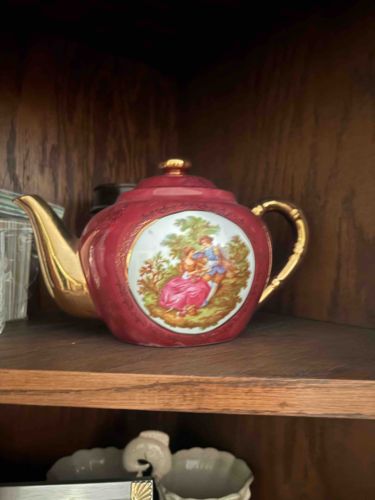
This is a decorative porcelain teapot featuring a rich, solid magenta or deep red body with extensive gold accents. The teapot has a bulbous, slightly flattened spherical form, indicative of antique or vintage tea service. The prominent feature is a large, oval-shaped reserve on the front, bordered by an intricate gold scroll pattern, depicting a romantic pastoral scene. Within this scene, two figures, likely a man and a woman in 18th-century European attire (possibly Rococo or Neoclassical era, given the style), are seated amidst lush green foliage and trees. The figures are rendered in a soft, painterly style with pastel colors. The spout and handle are entirely gilded, as is the finial on the lid, suggesting a significant amount of gold leaf or paint application. The lid itself is also magenta, matching the body. The craftsmanship appears to be of good quality, with fine detailing in the painted scene and consistent gilding. No obvious chips, cracks, or significant wear are visible from the image, but the exact condition of the gilding (whether it's tarnished or rubbed off in places) is hard to ascertain without closer inspection. The overall style suggests it could be from the late 19th or early 20th century, possibly a European (German or French inspired) or Japanese import aiming for an opulent, classical aesthetic. There are no discernible maker's marks or signatures visible in the provided image.
AI Appraisal Report
Upon visual examination of this Magenta Porcelain Teapot with Romantic Scene Medallion, I note its striking color and extensive gilt decoration. The bulbous form and Rococo-style romantic scene suggest a late 19th or early 20th-century European aesthetic, possibly German or French, or a high-quality Japanese export. The condition appears good from the image; I observe no obvious chips, cracks, or significant wear. However, the integrity of the gilding (tarnishing, rubbing) cannot be definitively assessed without a direct physical inspection.
Authenticity is difficult to ascertain from images alone. While typical of the period's decorative arts, visible maker's marks, impressed factory stamps, or artist signatures are absent in the provided view. Without such markings, confirming the pottery manufacturer, country of origin, and age is challenging.
Market conditions for decorative porcelain teapots, especially those mimicking historical styles, vary widely. Pieces from established manufacturers (e.g., Meissen, Sevres, Limoges, Capodimonte) with clear provenance and marks command premium prices. Unmarked examples, regardless of their beauty, typically fetch lower values unless attributed through expert opinion to a significant workshop. Demand for highly ornate items has seen fluctuations; while there's a niche market for 'grand millennial' or maximalist decor, the broader antique market prioritizes authenticity and documented history. Rarity is also hard to determine without makers' marks or production records.
Factors significantly impacting value include the actual physical condition of the gilding and porcelain, the presence of maker's marks, and documented provenance. An in-person examination is crucial to assess the true condition, examine the base for marks, and check for repairs. Scientific testing (e.g., XRF for gold composition, thermoluminescence for age) would be needed for definitive authentication of material and age if no marks are present.