These notes were written by the person who submitted this item. Appraiser.AI has not verified them, and the AI's identification and estimate may rely on them.
AI Estimated Value
Not an official valuation
$250 - $400
AI estimate as of October 9, 2025 · verify with a professional before acting
AI-Generated · Verify before acting
Everything on this page is generated by AI for informational purposes only. AI can make mistakes — the AI may misidentify items or misattribute them (artist, maker, brand, designer, origin, era). This is not an official valuation and should not be used for insurance, sale, tax, estate, legal, or lending purposes — or any decision requiring a certified appraisal. It is not an authoritative claim about any person, brand, or rights holder — do not share or rely on it as a factual statement about a third party. Always consult qualified professionals before making financial decisions.
This analysis also relies on unverified notes provided by the user, which may be incomplete or inaccurate and could affect the result.
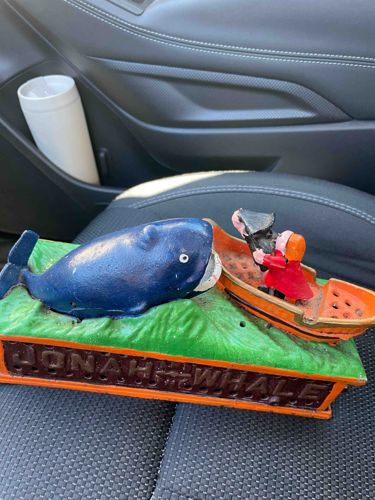
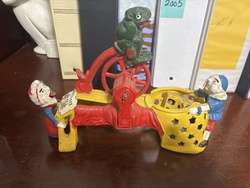
This is a vintage cast iron mechanical bank, likely originating from the early to mid-20th century, based on its construction and style. The bank depicts the biblical scene of Jonah and the Whale. The primary colors are blue for the whale, green for the 'water' or 'land' base, and orange for the boat and the base trim, with Jonah in red attire. The base is rectangular, featuring the embossed text 'JONAH & THE WHALE' on the front in raised capital letters, painted orange with the letters themselves appearing to be a darker, possibly unpainted or originally black, iron color. The whale is positioned on the left side of the green-painted 'surface,' with its mouth open, revealing some white teeth or inner mouth details. Its body is a deep blue with white eyes. On the right, an orange boat contains the figure of Jonah, dressed in a red coat and a dark-colored hat, and appears to be holding an implement, possibly a spear or staff, raised above his head. The boat has visible molded details, suggesting planks or panels. There's a small opening or slot in the green base near the boat, which is likely the coin entry point for the mechanical function. The bank exhibits considerable wear to the paint, with chips and loss of color especially noticeable on the whale's body, the green base, and the orange boat, revealing the dark gray cast iron beneath. There are no obvious signs of significant damage like cracks or repairs, but surface rust might be present under the flaked paint, characteristic of older cast iron pieces. The item's context suggests it's a collectible toy or decorative piece, emphasizing its mechanical function as a bank. The phrase 'No key' indicates that it is missing the original key required to open the coin retrieval mechanism, which is a common issue with vintage mechanical banks and can affect its functionality and value.
AI Appraisal Report
Upon examining the images provided of this Jonah and the Whale cast iron mechanical bank, my assessment is that it is likely a mid-20th-century reproduction of the original J. & E. Stevens model from the 1890s. The overall form is correct, but the paint coloration, particularly the bright orange base and boat, and the simplified details are more characteristic of later reproductions than the finer, more subdued finishes of an original. The condition reflects significant playwear, with substantial paint loss on the whale, base, and boat, exposing the cast iron beneath. Such wear is common but does reduce its value.
The market for mechanical banks remains strong, but there is a significant value distinction between original 19th-century examples and 20th-century reproductions. Originals in excellent condition can command values well over $1,500. Comparables for this reproduction, in similar worn condition, typically sell in the $250 to $400 range. The absence of the key for the coin trap is a notable negative factor, though it is a common issue and doesn't drastically decrease the value for a reproduction of this level.
My appraisal is limited by the inability to physically inspect the item. A complete authentication would require an in-person examination to check for maker's marks, analyze casting seam quality, and assess the weight and construction intricacies. Without such inspection or provenance, precise dating and attribution to a specific maker (original or reproduction) cannot be conclusively determined.