These notes were written by the person who submitted this item. Appraiser.AI has not verified them, and the AI's identification and estimate may rely on them.
AI Estimated Value
Not an official valuation
$20-40
AI estimate as of November 5, 2025 · verify with a professional before acting
AI-Generated · Verify before acting
Everything on this page is generated by AI for informational purposes only. AI can make mistakes — the AI may misidentify items or misattribute them (artist, maker, brand, designer, origin, era). This is not an official valuation and should not be used for insurance, sale, tax, estate, legal, or lending purposes — or any decision requiring a certified appraisal. It is not an authoritative claim about any person, brand, or rights holder — do not share or rely on it as a factual statement about a third party. Always consult qualified professionals before making financial decisions.
This analysis also relies on unverified notes provided by the user, which may be incomplete or inaccurate and could affect the result.
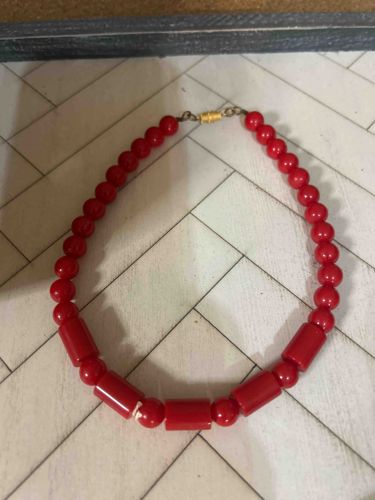
This is a vintage necklace, measuring approximately 15 inches in length and weighing 23 grams, strung on a white string. The necklace features a striking design composed of both round and barrel-shaped red beads, alternating to create a visually interesting pattern. The beads appear to be made of a synthetic material such as plastic or bakelite, given their uniform, bright crimson red color and glossy finish, which suggests a non-organic origin, although without tactile examination, natural coral cannot be entirely ruled out. The round beads are consistently sized, approximately 6-8mm in diameter, while the barrel-shaped beads are larger and elongated. The overall construction reveals a single strand design. A notable condition issue is visible in one section where the white string is exposed between two barrel beads, suggesting a loosening of the stringing or an intentional knotting point that has become visible over time. This exposure indicates a potential need for re-stringing to secure the beads and ensure durability. The clasp mechanism is a yellow-toned metal, possibly base metal or brass, featuring a magnetic closure, which is a common finding in jewelry from the mid to late 20th century. Adherence to a particular 'style period' would place this piece likely in the mid-century to late 20th century, given the type of materials and construction visible, as well as the magnetic clasp; however, without maker's marks or more definitive stylistic cues, an exact date is difficult. No visible manufacturer's marks, signatures, or stamps are discernible in the provided images. The uniform color and shape of the beads speak to mass production, but the specific material (e.g., bakelite, lucite, early plastics) would inform its collectibility.
AI Appraisal Report
Upon visual examination of this vintage red beaded necklace, I have assessed its characteristics to determine a fair market value. The piece measures 15 inches and features an alternating pattern of barrel and round beads, likely composed of a synthetic material such as plastic or lucite, common in mid to late 20th-century costume jewelry. The bright, uniform crimson color and glossy finish strongly suggest a man-made origin. The magnetic clasp, a later 20th-century innovation, supports this timeline. A significant factor impacting the value is the item's condition. The exposed white stringing between two beads indicates a need for restringing to ensure its integrity, which represents a potential cost to a future owner. Without any maker's marks, the necklace is attributed to mass production rather than a specific designer, which places it firmly in the costume jewelry category. The market for unsigned, mass-produced costume jewelry of this style is generally modest. Comparables for similar vintage plastic or lucite beaded necklaces from this era typically sell in the $20 to $40 range. While the necklace has a pleasant vintage aesthetic, its value is limited by the common materials, lack of a designer signature, and the noted condition issue. Full authentication of the bead material would require in-person testing. For example, a Simichrome test could help identify Bakelite, which would slightly increase its value. However, based on the visual evidence provided, I am appraising this as a piece of vintage costume jewelry.