AI estimate as of October 1, 2025 · verify with a professional before acting
AI-Generated · Verify before acting
Everything on this page is generated by AI for informational purposes only. AI can make mistakes — the AI may misidentify items or misattribute them (artist, maker, brand, designer, origin, era). This is not an official valuation and should not be used for insurance, sale, tax, estate, legal, or lending purposes — or any decision requiring a certified appraisal. It is not an authoritative claim about any person, brand, or rights holder — do not share or rely on it as a factual statement about a third party. Always consult qualified professionals before making financial decisions.
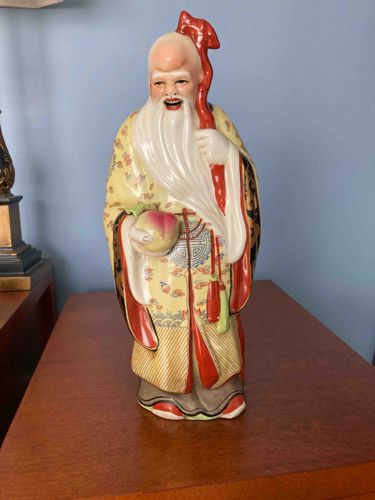
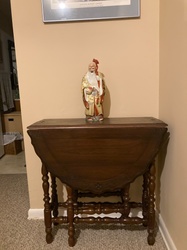
This is a Chinese porcelain statue depicting Shouxing, the God of Longevity, characterized by his prominent bald head and long white beard. The figure stands upright, holding a staff in his left hand and a peach, commonly associated with immortality, in his right hand. His face bears a joyful expression, with a wide smile revealing teeth, and small, expressive eyes. The statue is primarily made of glazed porcelain, featuring a vibrant polychrome enamel decoration. Shouxing is dressed in a yellow robe adorned with intricate patterns, including possibly auspicious symbols like bats (fu) and stylized clouds or flora, rendered in red, blue, green, and gold accents. The collar and cuffs of his robe are trimmed in red, with additional red elements forming tassels or sash details. His undergarments or inner robe appear to be a dark gray or brown hue, peeking out at the bottom. The base of the figure is integrated into the design, showing a subtle red and white layered border, suggesting a sturdy construction. The craftsmanship appears to be of good quality, with detailed painting and modeling, particularly in the facial features and the flowing beard. There are no immediately obvious chips, cracks, or repairs visible in the provided image, indicating a well-preserved condition or careful handling. The glossy finish of the glaze suggests a good quality porcelain. This type of statue typically dates from the mid-20th century, though without manufacturer's marks, a precise age is difficult to determine. The overall aesthetic is characteristic of traditional Chinese porcelain figures, often used for decorative purposes and as symbols of good fortune and long life.
AI Appraisal Report
I have examined the provided image of this Chinese porcelain statue depicting Shouxing, the God of Longevity. The overall condition appears to be very good, with no visible chips, cracks, or repairs. The polychrome enamel decoration is vibrant and well-preserved. The craftsmanship, particularly in the facial features and intricate patterns on the robe, suggests a good quality decorative piece. Authenticity, based solely on visual examination of an image, points to a mid-20th century production. The style and execution are consistent with traditional Chinese porcelain figures from that period, intended for decorative use.
Market conditions for such decorative Chinese porcelain figures are relatively stable. Comparables typically sell in the low to mid-hundred dollar range. While these pieces are popular for their auspicious symbolism, they are not rare. Demand is consistent among collectors of Asian decorative arts and individuals seeking symbolic representations of longevity and good fortune. Factors impacting value include the excellent condition, detailed decoration, and the universal appeal of Shouxing. However, the lack of a prominent manufacturer's mark, typical for mid-century export ware, prevents it from fetching higher prices associated with earlier or more renowned kilns.
It is crucial to note the limitations of authenticity verification from images alone. A full authentication would require in-person examination to assess the porcelain body, glaze quality, and decoration nuances intimately. Microscopic analysis could reveal details about the pigments and firing process. Furthermore, provenance documentation, such as original purchase receipts or family history, would significantly contribute to establishing its exact age and origin. Without these, a precise age within the mid-20th century range remains an estimate, and attribution to a specific workshop is not possible.