AI estimate as of September 21, 2025 · verify with a professional before acting
AI-Generated · Verify before acting
Everything on this page is generated by AI for informational purposes only. AI can make mistakes — the AI may misidentify items or misattribute them (artist, maker, brand, designer, origin, era). This is not an official valuation and should not be used for insurance, sale, tax, estate, legal, or lending purposes — or any decision requiring a certified appraisal. It is not an authoritative claim about any person, brand, or rights holder — do not share or rely on it as a factual statement about a third party. Always consult qualified professionals before making financial decisions.
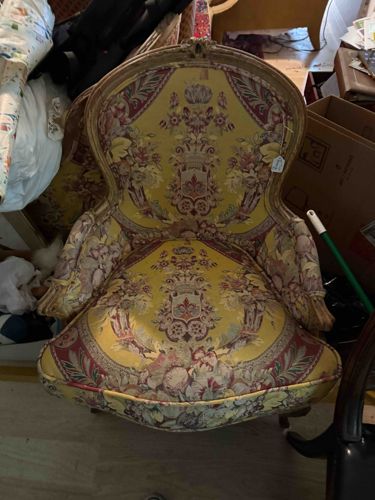
This is a Rococo Revival armchair, likely dating from the late 19th to early 20th century, inspired by the ornate French Louis XV style. The chair features a prominent carved wooden frame, which appears to have a distressed or antique gold leaf finish, exhibiting some wear and discoloration consistent with age. The frame outlines the backrest, arms, and potentially the lower front skirt, though the full extent of the frame is obscured by the upholstery. The backrest is curvilinear with an elaborate carved element at its crest, indicative of rococo aesthetics. The upholstery is a vibrant jacquard-woven fabric, dominated by shades of yellow with rich red, green, and blue accents. The pattern is highly detailed, featuring floral motifs, scrolls, and what appears to be a central armorial crest or cartouche on both the backrest and the seat cushion, suggesting a traditional European design influence, possibly French or Italian. The armrests are padded and covered in the same distinctive fabric, with decorative fringing or trim at their lower edge. The seat cushion is thick and also upholstered in the matching fabric. Condition issues visible include a general patina and some minor scuffs or wear to the gilded frame. The fabric, while still vibrant, shows some signs of age, including potential fading, slight discoloration, or surface dirt, particularly on the prominent yellow background. A small white tag is visible attached to the backrest, possibly an inventory or price tag. The craftsmanship appears to be of good quality, with well-defined carvings and intricate upholstery, characteristic of revival furniture that sought to emulate earlier grand styles. The overall impression is one of opulence and historical charm, despite its current placement amidst what appears to be storage or clutter.
AI Appraisal Report
Based on my visual examination of the provided image, this Rococo Revival armchair, dating from the late 19th to early 20th century, exhibits hallmarks of the Louis XV style. The carved wooden frame, with its distressed gilt finish and curvilinear forms, is characteristic of the period's revival furniture. The vibrant, jacquard-woven upholstery, featuring floral motifs and a central armorial crest, is striking and in keeping with the opulent aesthetic. The overall condition, while showing age-consistent patina and some wear to the gilt, appears good for its age. The fabric, while still vibrant, likely exhibits some fading or surface dirt, which is common. Craftsmanship appears solid, with well-defined carvings.
Market conditions for Rococo Revival pieces are generally stable, with a steady demand for well-preserved, ornate examples. Comparables include similar style armchairs from the same period, often fetching prices in the mid to high hundreds depending on condition and specific design. This chair's elaborate carving and distinctive upholstery likely place it on the higher end of that range. Rarity is moderate, as many such revival pieces were produced.
Factors significantly impacting value include the intactness and detail of the carving, the condition and quality of the upholstery, and the overall structural integrity. The visible tag might offer provenance if it reveals a maker or retailer, but its content is unreadable.
Limitations in authenticity verification from images alone are significant. While the style and apparent age are consistent with the description, a full in-person examination would be critical to confirm wood type, construction methods (e.g., joinery), original finish vs. later gilding, and the true condition of the upholstery and frame. Assessing fabric wear, structural wobbles, hidden repairs, or the authenticity of the 'distressed' finish cannot be definitively determined from a photograph. Provenance documentation (e.g., original sales receipts, family history) would also greatly assist in confirming authenticity and origin.