AI estimate as of August 7, 2025 · verify with a professional before acting
AI-Generated · Verify before acting
Everything on this page is generated by AI for informational purposes only. AI can make mistakes — the AI may misidentify items or misattribute them (artist, maker, brand, designer, origin, era). This is not an official valuation and should not be used for insurance, sale, tax, estate, legal, or lending purposes — or any decision requiring a certified appraisal. It is not an authoritative claim about any person, brand, or rights holder — do not share or rely on it as a factual statement about a third party. Always consult qualified professionals before making financial decisions.
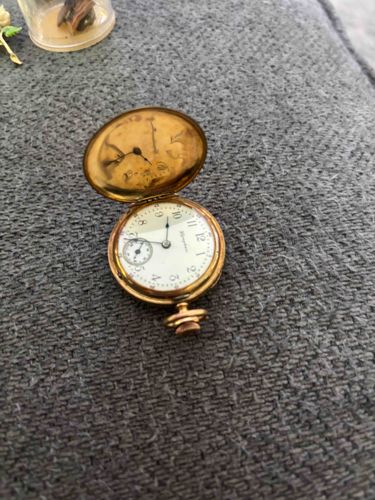
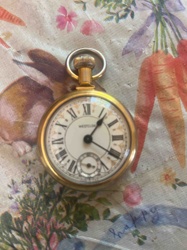
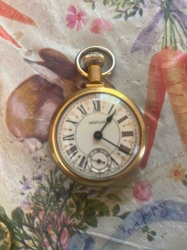
This item is an antique or vintage gold-toned pocket watch, likely made of brass, gold-filled metal, or a low-carat gold alloy, given the visible wear and patina. The watch features a classic hunting case design, with a hinged cover that protects the watch face. The cover, when opened, reveals a white enameled or porcelain dial with black Arabic numerals for hours 1 through 12. A small subsidiary seconds dial is located at the 6 o'clock position. The hands appear to be black or blued steel, in a simple spade or Breguet style. The watch's case exhibits significant wear, particularly on the hinged cover, where much of the original finish has rubbed off, revealing a darker, possibly brass, base metal underneath. This wear suggests frequent handling and use over a long period. The inside of the cover also shows discoloration and possible oxidation, with some light scratching. The winding stem and crown are positioned at the 3 o'clock mark, typical for open-face pocket watches, though this is a hunting case. The crown has a fluted design for easy gripping. The overall condition suggests a historical piece that has seen considerable use, indicated by the worn plating/finish. It is difficult to ascertain specific manufacturing details without seeing the movement or any internal markings, but the style suggests a late 19th to early 20th-century origin. The craftsmanship appears standard for mass-produced pocket watches of its era, not necessarily high-end luxury, but a functional and aesthetically pleasing timepiece.
AI Appraisal Report
Upon examining the provided image of the Gold-Toned Hunting Case Pocket Watch, I assess its condition as fair to good for its age. The significant wear on the gold-toned finish, particularly on the hinged cover revealing a darker base metal, indicates considerable use and age. This wear is consistent with a piece from the late 19th to early 20th century. The white dial with Arabic numerals and a subsidiary seconds dial appears intact, though I cannot ascertain any hairline cracks or chips from the image alone. The black hands seem appropriate for the period. Authenticity, based solely on this visual assessment, appears to be that of a genuine period pocket watch, not a modern replica. However, without inspecting the movement, case markings, or internal characteristics, I cannot confirm the manufacturer, specific material composition (e.g., gold-filled vs. low-karat gold alloy), or originality of all components. Verification of authenticity would necessitate a physical examination to check for serial numbers, hallmarks, and the condition of the internal mechanism. Market conditions for such utilitarian antique pocket watches are generally stable but not exceptionally strong unless attributed to a renowned maker or featuring unique complications. Comparables often range widely based on condition, maker, and material. Demand for common, mass-produced pocket watches like this is moderate; rarity is low unless specific manufacturing details reveal it to be an unusual variant. The primary factors impacting value here are the visible wear and the lack of verifiable maker information. Should the base metal be brass or gold-filled, the value is significantly lower than if it were solid low-karat gold. Without internal inspection to determine the movement's quality and functionality, and to identify any maker's marks, my valuation relies on conservative estimates for a generic, functional antique pocket watch in 'worn' condition.