AI estimate as of July 14, 2025 · verify with a professional before acting
AI-Generated · Verify before acting
Everything on this page is generated by AI for informational purposes only. AI can make mistakes — the AI may misidentify items or misattribute them (artist, maker, brand, designer, origin, era). This is not an official valuation and should not be used for insurance, sale, tax, estate, legal, or lending purposes — or any decision requiring a certified appraisal. It is not an authoritative claim about any person, brand, or rights holder — do not share or rely on it as a factual statement about a third party. Always consult qualified professionals before making financial decisions.
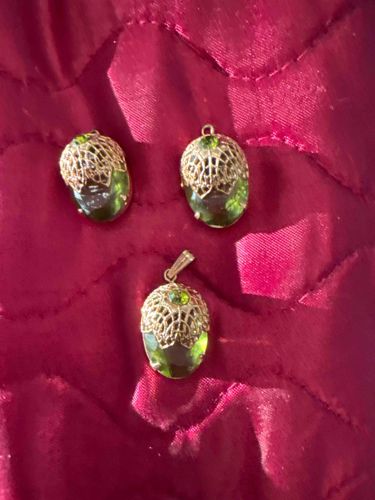
This item consists of a matching set of three pieces of jewelry: two earrings and one pendant, each designed to resemble an acorn. Each piece features a large, faceted, teardrop-shaped gemstone in a vibrant, translucent lime green color, simulating the body of an acorn. The 'cap' of each acorn is crafted from a gold-toned metal, intricately designed with an openwork filigree pattern that mimics the textured surface of an acorn cap. This filigree work appears to be quite delicate and detailed, suggesting fine craftsmanship. On top of the filigree cap, near where the bail or hook would attach, a small, circular, bright green gemstone (likely a rhinestone or small crystal) is set, adding an additional touch of sparkle and connecting visually to the main green stone. The pendant includes a small, gold-toned bail for attachment to a chain, while the earrings appear to have a loop for hook-style earring findings, though the actual hooks are not visible in the image. The metal components show a consistent gold tone, indicating either gold plating or a gold alloy. The condition appears to be good overall, with no obvious major damage like chips or cracks in the stones, or significant tarnish/wear on the metal. The items are shown on a rich, crimson fabric background, which provides a strong contrast and highlights the green of the stones. The style suggests a mid-20th century to contemporary period, leaning towards costume jewelry given the visible craftsmanship. The uniformity in design across all three pieces indicates they were manufactured as a coordinated set, aiming for an elegant yet playful botanical theme.
AI Appraisal Report
I have examined the provided image of this Acorn-Themed Green Gemstone Jewelry Set, consisting of a matching pair of earrings and a pendant. Visually, the set appears to be in good overall condition, with no obvious chips, cracks, or significant tarnishing visible. The intricate filigree detail on the gold-toned 'acorn caps' is well-preserved, and the vibrant lime green gemstones, which appear to be glass or a synthetic material, are intact. The small bright green 'rhinestones' atop the caps add a cohesive design element.
Authenticity, particularly regarding material composition and origin, is severely limited by image-only examination. I cannot definitively ascertain the material of the large green gemstones (e.g., natural peridot, tourmaline, or a synthetic type like glass or cubic zirconia) or the metal composition (e.g., solid gold, gold-filled, or gold-plated base metal). The craftsmanship, while detailed, suggests costume jewelry rather than fine jewelry, indicating the metal is likely plated.
Market conditions for vintage or costume jewelry with a botanical theme are generally stable, with demand for unique, well-preserved pieces. However, this particular design, while charming, does not appear to exhibit characteristics of high-end collectible costume jewelry brands (e.g., Miriam Haskell, Trifari) that command premium prices. The 'rarity' is likely moderate; while not mass-produced, it's also not a unique artisan piece from a renowned maker.
Factors significantly impacting value include the actual material of the green 'gemstones' (glass vs. natural stone), the metal content (gold plating vs. solid gold), and the maker, none of which can be confirmed from an image. For full authentication and accurate valuation, an in-person examination by a gemologist or jeweler is essential to test the gemstones and metal. Provenance documentation (original purchase receipts, maker's marks) would also be highly beneficial. Without this, my appraisal is based on the assumption of well-made costume jewelry from the mid-20th century to contemporary period.