AI estimate as of August 2, 2025 · verify with a professional before acting
AI-Generated · Verify before acting
Everything on this page is generated by AI for informational purposes only. AI can make mistakes — the AI may misidentify items or misattribute them (artist, maker, brand, designer, origin, era). This is not an official valuation and should not be used for insurance, sale, tax, estate, legal, or lending purposes — or any decision requiring a certified appraisal. It is not an authoritative claim about any person, brand, or rights holder — do not share or rely on it as a factual statement about a third party. Always consult qualified professionals before making financial decisions.
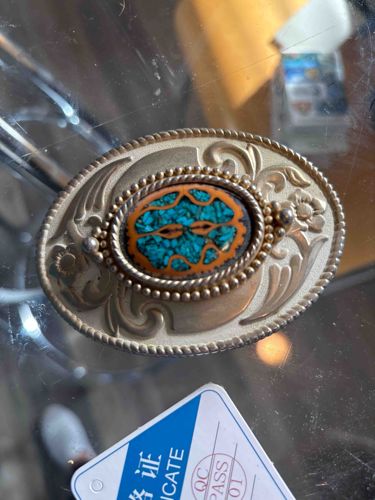
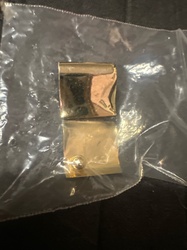
This is an oval-shaped belt buckle, likely fashioned from a silver-toned metal, possibly a base metal alloy with a silver plating or a nickel-silver alloy due to its somewhat matte, aged appearance. The buckle features an ornate Western or Southwestern style design. Its outer edge is bordered by a continuous rope-twist motif, adding a textured, classic detail. The main body of the buckle is decorated with swirling, stylized floral or scroll engravings, which are symmetrically arranged, emanating from the central bezel. The engraving work appears to be cast or stamped, rather than hand-chiseled, indicating a more industrial manufacturing process, although the detail is still clear. The central focal point is an elevated, oval-shaped bezel setting, which is also edged with a rope-twist pattern and small bead-like details around its perimeter, creating a frame for the intricate inlay. Inside this bezel, there is a mosaic-like inlay composed of pieces of turquoise set against a reddish-brown matrix or background, which appears to be spiny oyster shell or a resin/epoxy simulating it. The turquoise pieces are irregular in shape and size, fitted together to create a striking pattern with visible matrix lines, giving it an authentic, natural stone appearance. The color of the turquoise is a vibrant blue-green, characteristic of natural turquoise. There are visible signs of wear consistent with age and use, including minor surface scratches and a dark patina in the recessed areas of the metal, which actually enhances the detailing. The piece appears to be in good overall condition, with the inlay intact and no obvious major damage or repairs visible. Based on the style and materials, it likely dates from the mid to late 20th century, probably a vintage piece reflecting either Native American-inspired or cowboy/Western fashion trends. The craftsmanship, while not artisanal, demonstrates good quality for a mass-produced or semi-handcrafted accessory.
AI Appraisal Report
Upon examining this oval Western/Southwestern style belt buckle, I note its good overall condition, consistent with vintage use. The design features a prominent rope-twist border and scrollwork on a silver-toned metal, which, based on visual cues like its matte finish and patina, is likely a silver-plated base metal or a nickel-silver alloy rather than sterling silver. The central inlay is a vibrant mosaic of turquoise and what appears to be spiny oyster shell, a classic combination in Southwestern jewelry. The craftsmanship suggests a well-made, likely mass-produced or semi-handcrafted piece from the mid-to-late 20th century, rather than a fine, artisan-signed creation.
The current market for vintage Western wear accessories is steady. While this buckle is aesthetically pleasing, its value is significantly impacted by the probable use of non-precious metals and the lack of an identifiable maker's mark. Comparable unsigned, non-sterling buckles with similar inlay work typically sell in the lower price range in online marketplaces and at antique malls. The primary value drivers here are its stylistic appeal and decorative quality.
It is crucial to note the limitations of this appraisal, as it is based solely on images. A definitive valuation would require an in-person examination to test the metal content (e.g., acid or electronic testing to confirm if it is sterling silver) and to verify if the stones are natural turquoise and shell versus synthetic simulations. Without such tests or any provenance, authenticity cannot be guaranteed, and the valuation reflects this uncertainty.