AI Appraisal Estimate

AI-generated estimates · not official valuations

From the user

What was submitted

Photo and notes provided by the user — not generated by AI

Submitted item photo
Submitted photo · June 6, 2026

User's notes

signed and notorized

AI analysis below

AI appraisal

AI analysis & estimate

AI-Generated · Verify before acting

Everything below is generated by AI for informational purposes only. AI can make mistakes — the AI may misidentify items or misattribute them (artist, maker, brand, designer, origin, era). This is not an official valuation and should not be used for insurance, sale, tax, estate, legal, or lending purposes — or any decision requiring a certified appraisal. It is not an authoritative claim about any person, brand, or rights holder — do not share or rely on it as a factual statement about a third party. Always consult qualified professionals before making financial decisions.

Note

This analysis also relies on unverified notes provided by the user, which may be incomplete or inaccurate and could affect the result.

Read the full disclaimer

AI Identification

·Not independently authenticated·Verify before acting

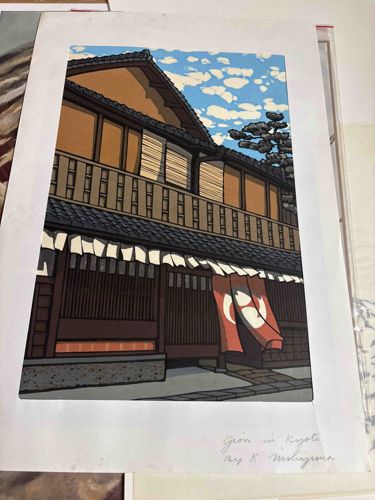
Gion in Kyoto by K. Makiyama

Art Print

AI Estimated Value

·Not an official valuation·Verify before acting

$75 - $150

As of June 6, 2026

AI Item Analysis

·AI can make mistakes·Verify before acting
This is a color woodblock print, or possibly a reproduction of one, depicting a traditional Japanese street scene, specifically identified by the handwritten inscription as 'Gion in Kyoto'. The print features a two-story building with a distinctive dark grey tiled roof, typical of Japanese architecture. The upper story is characterized by light brown wooden walls and a series of windows, some of which appear to have slatted shutters. A dark brown wooden railing or balcony runs across the front of the upper floor. The lower story is also dark brown, with latticed or slatted elements, and features a prominent red noren (entrance curtain) with white circular or floral motifs. Below the red noren, there's a small section of a lighter red-orange foundation. The building stands on a grey sidewalk with etched lines suggesting paving stones or brickwork. In the background, a clear blue sky is filled with numerous whimsical, scattered white clouds, and a portion of a dark green, stylized pine tree is visible on the right. The overall color palette is somewhat muted yet vibrant, contrasting the deep browns and greys of the architecture with the bright blue sky and the striking red of the noren. The print appears to be on a heavy paper or board, with a significant white border surrounding the image. There are no visible major condition issues such as tears or significant creases, but it is difficult to assess the exact condition without direct inspection. The craftsmanship indicates a detailed illustrative style. The handwritten signature 'by K. Makiyama' suggests the artist's name. Given the subject matter and the medium, it likely dates from the mid to late 20th century, common for such evocative Japanese landscape or city scene prints.

AI Appraisal Report

·AI can make mistakes·Verify before acting
Upon examining the provided image of the woodblock print 'Gion in Kyoto' by K. Makiyama, my appraisal is based on its visual characteristics. The piece appears to be a 20th-century color woodblock print, exhibiting a popular theme of traditional Japanese cityscapes. The condition, as seen in the image, seems good, with no obvious tears, foxing, or significant fading, which is a positive factor for its value. The signature 'by K. Makiyama' identifies the artist, but K. Makiyama is not among the highly coveted masters of the shin-hanga or sōsaku-hanga movements, which places the work in a more decorative category. Market comparables for similar 20th-century Japanese decorative prints by less-renowned artists typically range from $50 to $200. The demand for such pieces is steady among decorators and collectors of Japanese art, but they do not command the high prices of works by artists like Hasui Kawase or Hiroshi Yoshida. The fact that the print is signed is beneficial, but the mention of 'notarized' does not add to its market value, as notarization only verifies the identity of the person signing a document, not the authenticity of the artwork itself. The key limitation of this appraisal is the inability to physically inspect the item. Without seeing it in person, I cannot definitively determine if it is an original hand-pulled woodblock print or a later mechanical reproduction, a critical distinction for value. An in-person examination would be required to analyze the paper fibers, ink bleed-through, and impression marks (baren suji) characteristic of an authentic woodblock print. Full authentication would also benefit from provenance records tracing its ownership history.

Get your items appraised

Instant estimates of your treasures with AI-powered appraisals

Browse More Appraisals