AI estimate as of August 6, 2025 · verify with a professional before acting
AI-Generated · Verify before acting
Everything on this page is generated by AI for informational purposes only. AI can make mistakes — the AI may misidentify items or misattribute them (artist, maker, brand, designer, origin, era). This is not an official valuation and should not be used for insurance, sale, tax, estate, legal, or lending purposes — or any decision requiring a certified appraisal. It is not an authoritative claim about any person, brand, or rights holder — do not share or rely on it as a factual statement about a third party. Always consult qualified professionals before making financial decisions.
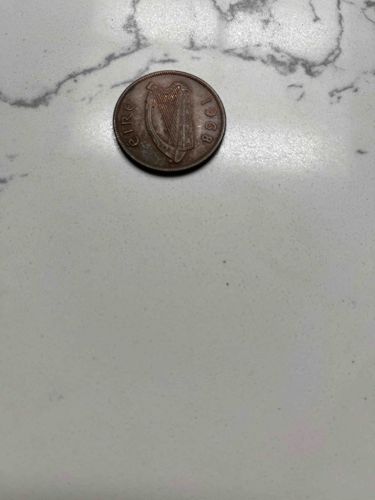
The item is a circular, metallic coin, likely made of bronze or a copper alloy, judging by its reddish-brown color and visible patina. The obverse side of the coin is clearly depicted, featuring a prominent harp design at its center, which is a traditional symbol of Ireland. This harp appears to be a representation of the Brian Boru harp, recognizable by its specific shape and string arrangement, which often includes a column. Surrounding the harp, along the rim of the coin, are inscriptions. To the left of the harp, the word "EIRE" is visible, which is the Irish name for Ireland. To the right of the harp, the year "1968" is clearly legible, indicating its minting date. The surface of the coin exhibits signs of wear consistent with age and circulation, including some loss of fine detail on the harp and a general smoothing of the raised elements. There is a noticeable dark greenish-brown patina across the surface, which is typical for aged copper-based coins, suggesting a natural oxidation process rather than recent damage. No significant scratches, dents, or other forms of severe physical damage are immediately apparent, though minor surface abrasions are present. The rim appears to be intact, and the overall shape is well-preserved. This coin is an example of an Irish pre-decimal currency coin, specifically a halfpenny or penny due to its common use of the harp motif and typical metal composition for these denominations during that period. The clarity of the date and country name suggests a good level of original strike quality. The coin's condition would be considered circulated, with an attractive, natural patina.
AI Appraisal Report
Based on my examination of the provided image of this 1968 Irish coin, featuring the traditional harp design and the inscriptions "EIRE" and "1968," I can offer the following appraisal. The coin appears to be a common pre-decimal Irish denomination, likely a half-penny or penny given the prevalent use of the harp motif on these coins. Its reddish-brown tone and visible patina strongly suggest it is made of bronze or a copper alloy, which is consistent with these denominations from that period. The condition exhibits typical wear from circulation, including some smoothing of details on the harp and general surface abrasions, but no severe damage like deep scratches or dents. The natural, dark greenish-brown patina is attractive and indicates stable preservation. The clarity of the date and country name is good, suggesting a decent original strike.
In terms of market conditions, Irish pre-decimal coins from the late 1960s are generally common. Coins of this type and condition typically do not command high prices unless they possess unique errors or exceptional uncirculated grades, neither of which appears to be the case here. Demand is moderate, primarily from collectors seeking to complete sets or acquire circulated examples of Irish coinage. Rarity is low for this specific year and denomination in this condition. Factors significantly impacting value are largely negative here; its commonness and circulated state prevent it from being a high-value item.
It is crucial to note the limitations of image-based appraisal. While the image provides a good indication of condition and authenticity, a definitive verification would require in-person examination to assess the coin's weight, diameter, edge, and precisely grade the surface details. Microscopic examination could confirm the nature of the patina and rule out any artificial toning or damage not visible in the image. Provenance documentation, though unlikely to significantly alter the value of such a common coin, could offer additional historical context. Scientific testing (e.g., XRF analysis) would confirm the exact metallic composition.