These notes were written by the person who submitted this item. Appraiser.AI has not verified them, and the AI's identification and estimate may rely on them.
AI Estimated Value
Not an official valuation
$150-250
AI estimate as of July 12, 2025 · verify with a professional before acting
AI-Generated · Verify before acting
Everything on this page is generated by AI for informational purposes only. AI can make mistakes — the AI may misidentify items or misattribute them (artist, maker, brand, designer, origin, era). This is not an official valuation and should not be used for insurance, sale, tax, estate, legal, or lending purposes — or any decision requiring a certified appraisal. It is not an authoritative claim about any person, brand, or rights holder — do not share or rely on it as a factual statement about a third party. Always consult qualified professionals before making financial decisions.
This analysis also relies on unverified notes provided by the user, which may be incomplete or inaccurate and could affect the result.
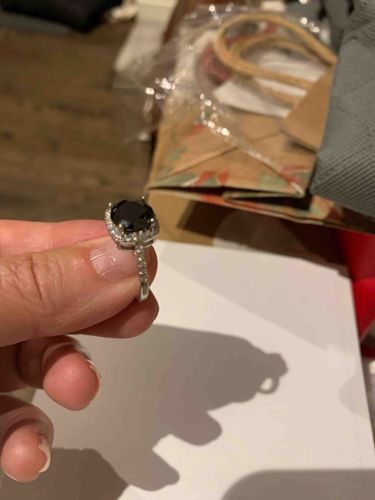
This item is a ring featuring a prominent dark, likely black, cushion-cut or square-shaped gemstone as its central focus. The main stone is surrounded by a halo of smaller, clear, round brilliant-cut stones, which also extend down the shoulders of the band, creating a pave or micro-pave setting on the upper half of the ring. The metal appears to be a white metal, possibly silver, white gold, or platinum, given its bright, reflective quality and lack of discoloration. The main gemstone exhibits a high polish and appears opaque, suggesting materials such as black onyx, black spinel, or potentially a treated diamond, though without further testing, its exact identity is difficult to ascertain from the image alone. The 'Moissante' context provided suggests the main stone could be a black moissanite or if that is the case the surrounding stones might be moissanite as well, or the surrounding stones could be cubic zirconia or small diamonds. The craftsmanship appears to be of good quality, with the stones well-set and the metal showing a smooth finish. There are no immediately visible signs of significant wear, damage, or repairs, maintaining a clean and elegant appearance. The design suggests a contemporary style, likely from the late 20th or early 21st century, often seen in engagement, cocktail, or dress rings. The size of the central stone relative to the band suggests it is a substantial piece of jewelry. The setting type for the main stone appears to be a prong setting, securing the large stone firmly, while the halo and side stones are likely bead or micro-prong set for a seamless, glittering effect.
AI Appraisal Report
Upon examining the provided image and information, this item is a contemporary-style halo ring. The centerpiece is a prominent, square cushion-cut black gemstone, identified by the owner as moissanite. This central stone is secured by a four-prong setting and encircled by a halo of smaller, round brilliant-cut stones that extend down the shoulders of the band in a pavé setting. The metal is a white metal, likely sterling silver or white gold-plated sterling silver, given the typical pairing with moissanite in this price category. Without maker's marks or metal purity stamps, I cannot confirm if it is a precious metal like white gold or platinum, which would significantly alter the value. The craftsmanship appears to be of good commercial quality, with the stones securely set and the metal showing a high polish. The overall condition is excellent, with no visible damage or significant wear.
Market comparables for black moissanite halo rings in sterling silver or silver-plated settings are readily available. The value is primarily driven by the moissanite stones and the setting's intricacy rather than the metal. Demand for moissanite as a diamond alternative remains strong due to its durability and brilliance at an accessible price point. The black variant offers a modern, bold aesthetic that is popular but less common than colorless moissanite, which does not significantly impact its value.
Limitations: This appraisal is based solely on visual inspection of an image. A definitive valuation requires physical examination to test the metal's purity (e.g., acid or XRF testing), confirm the identity and quality of all gemstones, and assess the overall construction quality and weight.