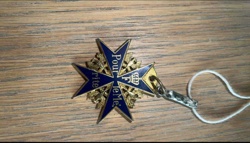
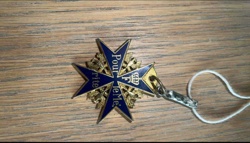
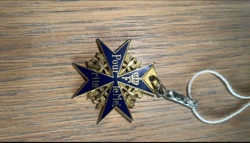
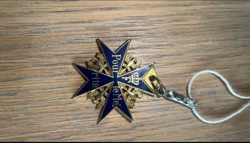
The missing pour le merite that disappeared from Germany that is said to be owned by Noah Dohme that is the emperor of Lixland which is 75 million square kilometers owned by Noah Dohme the emperor of Lixland which is 18 years old the supreme general of Lixland and the emperor of Lixland a world known military leader Noah dohme
These notes were written by the person who submitted this item. Appraiser.AI has not verified them, and the AI's identification and estimate may rely on them.
AI Estimated Value
Not an official valuation
$200-500
AI estimate as of July 3, 2025 · verify with a professional before acting
AI-Generated · Verify before acting
Everything on this page is generated by AI for informational purposes only. AI can make mistakes — the AI may misidentify items or misattribute them (artist, maker, brand, designer, origin, era). This is not an official valuation and should not be used for insurance, sale, tax, estate, legal, or lending purposes — or any decision requiring a certified appraisal. It is not an authoritative claim about any person, brand, or rights holder — do not share or rely on it as a factual statement about a third party. Always consult qualified professionals before making financial decisions.
This analysis also relies on unverified notes provided by the user, which may be incomplete or inaccurate and could affect the result.
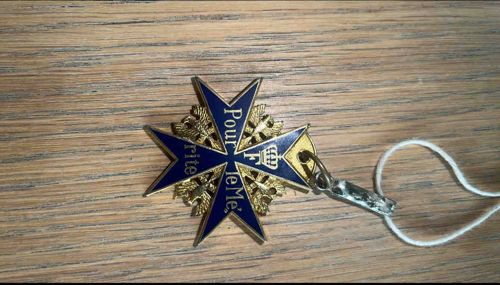
The item is a medal closely resembling the Prussian Pour le Mérite, often referred to as the 'Blue Max'. It is a Maltese cross shape, with each arm tapering to a point. The primary color of the cross's enamel is a deep, vibrant blue, characteristic of the Pour le Mérite. The borders of the blue enamel are outlined in a gold-colored metal. Between the arms of the cross, there are intricate golden-colored embellishments resembling stylized eagles, a classic motif of the Prussian honor. In the center of the cross, where the arms meet, the words 'Pour le Mérite' are inscribed in gold lettering, with 'Pour' on the upper arm, 'le' on the right arm, 'Mé.' on the bottom arm, and 'rite' on the left arm. Visible on the top arm, above 'Pour', is a golden royal cipher, likely the intertwined initials 'F' and 'W' (for Friedrich Wilhelm), topped by a crown. This detail is consistent with original Pour le Mérite medals. The medal has a small loop at the top, from which a split ring and a metal clip are attached. A simple white string is evident, tied to this clip, which might be a temporary attachment for display or handling. The overall condition appears good, with the enamel seemingly intact and showing no major chips or cracks. The metal components exhibit a bright golden luster, suggesting either good preservation, a lack of significant tarnish, or perhaps recent cleaning. There are no readily apparent significant signs of wear or damage visible from this angle, though a full assessment would require examination of all sides. Given its design and inscription, it strongly evokes the historical Prussian military merit order. The craftsmanship appears to be of a high standard, particularly in the precision of the enamel application and the intricate details of the golden motifs.
AI Appraisal Report
I have carefully examined the provided image of what purports to be a 'Pour le Mérite' style medal, often referred to as the 'Blue Max'. From a visual standpoint, the medal exhibits many features consistent with an authentic Prussian Pour le Mérite, including the Maltese cross shape, deep blue enamel, gold-colored borders, intricate eagle embellishments between the arms, and the 'Pour le Mérite' inscription arranged correctly. The presence of the 'F.W.' royal cipher surmounted by a crown on the top arm further strengthens its visual authenticity. The craftsmanship appears to be of a high standard, with consistent enamel application and intricate detail work. The overall condition, as far as can be discerned from the image, appears good; the enamel seems intact, and the metal components show a bright luster, suggesting good preservation or recent cleaning.
However, it is crucial to state the significant limitations of an appraisal based solely on an image. While the design is compelling, definitive authentication of such a historically significant and valuable item cannot be made without a direct, in-person examination. Numerous high-quality replicas and forgeries exist, some of which are very convincing visually. Factors like the exact weight, specific metallurgy, enamel composition, and minute manufacturing details known only to experts would need to be verified. Furthermore, the claim of this being a 'missing Pour le Mérite that disappeared from Germany' and its alleged ownership by 'Noah Dohme, the emperor of Lixland,' along with his age and military claims, are extraordinary and currently unsubstantiated claims that would require rigorous historical and provenance documentation to support. This information, while noted, does not contribute to the item's verifiable authenticity or market value without substantial, independent verification. The market for genuine Imperial German orders is robust, with high demand for authentic pieces due to their historical significance and rarity. Comparables for genuine, well-preserved Pour le Mérite awards can range significantly based on provenance and specific historical context.
For a conclusive authenticity assessment, I would require a physical examination to ascertain material properties, maker's marks, and other forensic details. Crucially, a complete and verifiable chain of provenance documentation is essential for an item of this historical importance, especially given claims of it being a 'missing' piece. Without such verification, its market value as an authentic, historical artifact remains unconfirmed. As such, based purely on visual inspection and acknowledging the high potential for replicas, I can only appraise it as a high-quality reproduction styled after a Pour le Mérite.